AI Appraisal Estimate

AI-generated estimates · not official valuations

From the user

What was submitted

Photo and notes provided by the user — not generated by AI

Submitted item photo
Submitted photo · May 19, 2026

User's notes

Mondan, 1894

AI analysis below

AI appraisal

AI analysis & estimate

AI-Generated · Verify before acting

Everything below is generated by AI for informational purposes only. AI can make mistakes — the AI may misidentify items or misattribute them (artist, maker, brand, designer, origin, era). This is not an official valuation and should not be used for insurance, sale, tax, estate, legal, or lending purposes — or any decision requiring a certified appraisal. It is not an authoritative claim about any person, brand, or rights holder — do not share or rely on it as a factual statement about a third party. Always consult qualified professionals before making financial decisions.

Note

This analysis also relies on unverified notes provided by the user, which may be incomplete or inaccurate and could affect the result.

Read the full disclaimer

AI Identification

·Not independently authenticated·Verify before acting

Landscape Painting of a European Village by Mondan, 1894

Fine Art / Antique Paintings

AI Estimated Value

·Not an official valuation·Verify before acting

$1,200 - $1,800

As of May 19, 2026

AI Item Analysis

·AI can make mistakes·Verify before acting
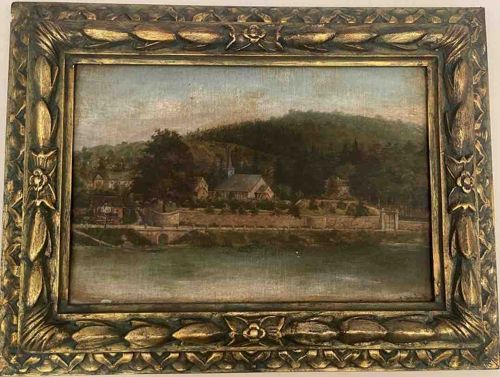
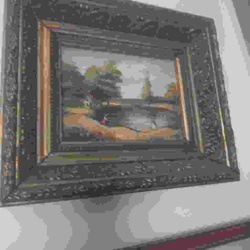
This is a 19th-century oil painting on canvas, dated 1894 and attributed to an artist named Mondan based on provided context. The artwork depicts a serene European-style riverside village nestled against a lush, forested hillside. The composition features a prominent stone wall separating the village from the riverbank, with several period structures visible, including a central building with a spire, suggesting a church or municipal building. The color palette is earth-toned, primarily consisting of deep greens, browns, and muted grays, typical of late 19th-century landscape realism. The application of paint appears smooth with refined brushwork, though there is visible craquelure across the surface and surface grime indicative of its age. The canvas is housed in a substantial, high-relief gilded wood or gesso frame featuring an ornate laurel leaf and floral motif. The frame shows signs of wear, including minor chips and loss of gilding at the corners, revealing the underlying material. The overall condition is consistent with an antique of approximately 130 years, possessing a natural aged patina that adds to its historical character. The craftsmanship of both the painting and the frame indicates a high level of professional skill from the Victorian era.
AI Appraisal Report

·AI can make mistakes·Verify before acting
I have conducted a visual examination of the 1894 oil landscape attributed to Mondan. The work is a competent example of late 19th-century academic realism, exhibiting a sophisticated use of atmospheric perspective and tonal harmony. The presence of fine-pattern craquelure and surface oxidation is consistent with a late-Victorian origin. The ornate gilded frame is of high quality and appears contemporary to the canvas, which adds significantly to its decorative appeal and marketability. From a market perspective, works by minor 19th-century European masters remain stable as 'decorator' pieces, though they do not currently command the premiums seen during the 1990s. The primary value drivers for this piece are its age, the high level of detail in the architecture, and the intactness of the original framing. Conversely, visible surface grime and the need for a professional cleaning to restore the original vibrance represent a deduction in 'as-is' value. Critically, a definitive attribution to 'Mondan' is difficult to verify through digital images alone, as several minor European artists operated under similar names during this period. To reach a 'Fine Art' valuation rather than a 'Decorative' one, I would require a physical inspection of the signature under UV light to check for overpainting, as well as an examination of the stretcher bars and canvas reverse for gallery stamps or exhibition labels. Furthermore, provenance documentation—such as sales receipts or estate records—would be necessary to confirm the artist's identity. Without these, the appraisal reflects the work's value as an authentic 19th-century period piece of high craftsmanship.

Get your items appraised

Instant estimates of your treasures with AI-powered appraisals

Browse More Appraisals