AI estimate as of October 5, 2025 · verify with a professional before acting
AI-Generated · Verify before acting
Everything on this page is generated by AI for informational purposes only. AI can make mistakes — the AI may misidentify items or misattribute them (artist, maker, brand, designer, origin, era). This is not an official valuation and should not be used for insurance, sale, tax, estate, legal, or lending purposes — or any decision requiring a certified appraisal. It is not an authoritative claim about any person, brand, or rights holder — do not share or rely on it as a factual statement about a third party. Always consult qualified professionals before making financial decisions.
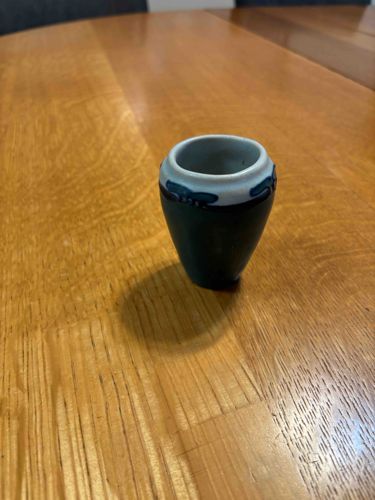
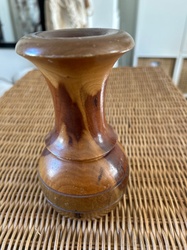
This is a small ceramic bud vase, characterized by its compact size and elegant silhouette. The vase measures approximately 3-4 inches in height, with a narrow opening at the top and a slightly wider body that tapers towards the base. The primary color of the body is a deep, dark green, possibly a forest or hunter green, which has a matte or satin finish. The upper rim features a contrasting light grey or off-white band, providing a subtle two-tone effect. This lighter band is adorned with an embossed or raised decorative pattern, appearing as stylized organic forms or flourishes in a darker shade, likely a dark blue or black, which extends slightly onto the dark green body. The design has an almost Celtic or Art Nouveau feel, adding a touch of intricate detail to an otherwise simple form. The interior of the vase opening is also finished in the same light grey/off-white color, indicating a glazed or finished interior. There are no immediately visible chips, cracks, or significant damage, suggesting it is in good to excellent condition for its age. The craftsmanship appears to be of good quality, with smooth transitions between colors and a well-defined embossed pattern. Without a view of the base, manufacturing marks are not discernible. The style suggests it could be a piece from the mid-20th century or later, perhaps a studio pottery piece or a mass-produced decorative item with artisanal flair. Its small size makes it ideal for holding a single flower or a small sprig.
AI Appraisal Report
Having closely examined the provided image of this small ceramic bud vase, I find it to be in good to excellent condition visually, showing no apparent chips, cracks, or significant surface damage. The craftsmanship appears competent, with a well-defined embossed pattern and smooth color transitions, indicating it's likely a mass-produced item with a decorative aesthetic, or possibly a studio pottery piece of modest artisanry, rather than fine art pottery. The two-tone design, dark green body with a lighter embossed rim, gives it a pleasing visual appeal.
From a market perspective, small decorative vases of this nature, without definitive artist signatures or proven provenance, typically fall into a modest price tier. Comparables in the secondary market, such as online marketplaces or antique shops, suggest a value based primarily on aesthetic appeal and condition. Demand for such pieces is generally steady but not exceptionally high, as they are common decorative items. Rarity is not a significant factor here; similar items, though not identical, are widely available.
The main factors influencing value are its clean condition and attractive, possibly Art Nouveau-inspired, design. Limitations in authentication are significant; without a physical inspection, specific manufacturing marks on the base cannot be verified, which would be crucial for identifying a maker or origin. An in-person examination would also allow for a tactile assessment of material quality and glaze, while provenance documentation could connect it to a particular artist or factory, potentially increasing its value. Without these, it remains a charming but unauthenticated decorative item.