AI estimate as of October 8, 2025 · verify with a professional before acting
AI-Generated · Verify before acting
Everything on this page is generated by AI for informational purposes only. AI can make mistakes — the AI may misidentify items or misattribute them (artist, maker, brand, designer, origin, era). This is not an official valuation and should not be used for insurance, sale, tax, estate, legal, or lending purposes — or any decision requiring a certified appraisal. It is not an authoritative claim about any person, brand, or rights holder — do not share or rely on it as a factual statement about a third party. Always consult qualified professionals before making financial decisions.
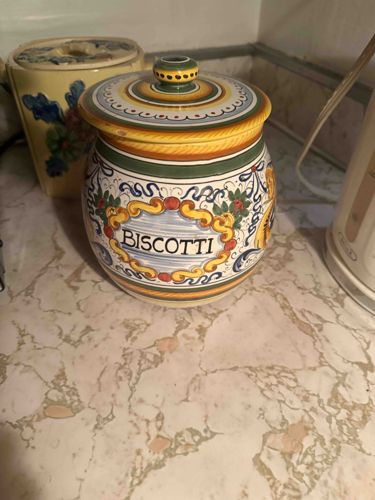
This is a ceramic biscotti jar, characterized by its vibrant, multi-colored Italian Majolica-style hand-painted decoration. The jar is of a classic cylindrical shape with a slightly tapered bottom and a fitted lid, topped with a domed finial. The primary colors evident in the ornamentation include a bright yellow, deep forest green, sky blue, earthy red-orange, and off-white. The lid features a concentric design with a green finial, a yellow band, and a lighter band with a scalloped blue edge and small red dots. The body of the jar is divided into bands; a top band of dark green, a wider central band in off-white adorned with intricate scrollwork and floral motifs, and a lower yellow band matching the lid. The central off-white band prominently features a cartouche-like design with the word 'BISCOTTI' in dark lettering, framed by scrolling yellow and red-orange elements, and flanked by stylized greenery and berries. The overall aesthetic suggests a traditional Italian ceramic craftsmanship, likely from the mid-to-late 20th century or early 21st century, designed for kitchen or pantry storage. The hand-painted nature indicates individual artistic effort, and while no specific maker's marks are visible in the image, the style is reminiscent of pottery from regions like Deruta or Vietri Sul Mare. The condition appears good from the visible angles, with no obvious chips, cracks, or significant wear. The glossy glaze is intact, reflecting light, and contributes to the item's decorative appeal and utility for food storage.
AI Appraisal Report
I have examined the provided image of this Italian Majolica-style Biscotti Jar. Visually, the jar appears to be in very good condition, with its glossy glaze intact and no obvious chips, cracks, or significant wear. The hand-painted, multi-colored decoration is vibrant and consistent with Italian Majolica-style ceramics, featuring classic motifs such as scrollwork, florals, and a cartouche for 'BISCOTTI'.
Authenticity, based solely on the image, points to a decorative ceramic piece in the traditional Italian style, likely from the mid-to-late 20th century or early 21st century. While the style is reminiscent of regions like Deruta or Vietri Sul Mare, definitive authentication without maker's marks is challenging. Market conditions for contemporary decorative Italian Majolica-style kitchenware are generally stable, with demand driven by those seeking traditional aesthetic or functional kitchen items. This jar holds value as a decorative storage piece. Its hand-painted nature adds to its appeal, but it is not rare, as similar items are produced for a wide market.
Factors impacting value include its good condition, attractive decoration, and functional purpose. However, the absence of a confirmed maker's mark or specific provenance limits its 'collector's item' status. Its value is primarily as a decorative and functional household item rather than a collectible antique.
For full authentication, an in-person examination would be crucial to inspect for any subtle imperfections, assess the quality of the ceramic body and paint application more closely, and search for any hidden marks or signatures. Provenance documentation, if available, would significantly aid in establishing its origin and potential artisan, potentially increasing its value. Scientific testing is generally not applied to items of this nature unless there are specific historical claims to verify.