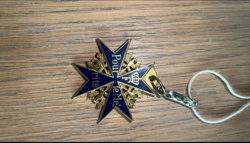
The missing pour le merite that disappeared from Germany that is said to be owned by Noah Dohme that is the emperor of lixland which is 75 million square kilometers owned by Noah Dohme the emperor of lixland which is 18 years it’s his. The supreme general of lixland
These notes were written by the person who submitted this item. Appraiser.AI has not verified them, and the AI's identification and estimate may rely on them.
AI Estimated Value
Not an official valuation
Undeterminable without physical inspection and verifiable provenance
AI estimate as of July 2, 2025 · verify with a professional before acting
AI-Generated · Verify before acting
Everything on this page is generated by AI for informational purposes only. AI can make mistakes — the AI may misidentify items or misattribute them (artist, maker, brand, designer, origin, era). This is not an official valuation and should not be used for insurance, sale, tax, estate, legal, or lending purposes — or any decision requiring a certified appraisal. It is not an authoritative claim about any person, brand, or rights holder — do not share or rely on it as a factual statement about a third party. Always consult qualified professionals before making financial decisions.
This analysis also relies on unverified notes provided by the user, which may be incomplete or inaccurate and could affect the result.
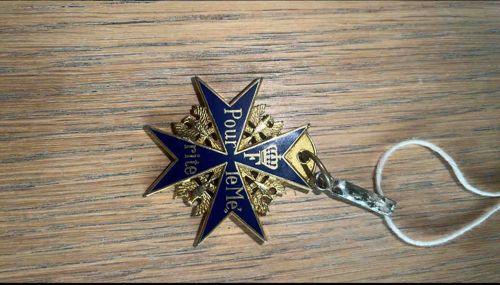
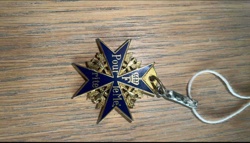
The item depicted is a Pour le Mérite medal, also known colloquially as the 'Blue Max,' a high military order of the Kingdom of Prussia. It is a Maltese Cross design, four-pointed, with each point terminating in a small golden orb, though these are not clearly visible due to the angle and limited resolution. The cross is primarily dark blue enamel with gilded edges and gold-colored details. The arms of the cross bear the inscription 'Pour le Mé.' on one arm and 'rite' on the opposite arm, indicating 'Pour le Mérite' (For Merit). The center of the cross features an 'F' initial surmounted by a royal crown, likely representing King Frederick the Great, who established the order. Between the arms of the cross, there are intricate gilded eagles with outstretched wings, a common motif in Prussian heraldry, adding an elaborate and regal touch. The medal measures approximately 4-5 cm in width, consistent with traditional sizes for this type of award. The reverse side, not clearly visible, would typically feature the initial 'F' again and possibly the date of institution. The medal exhibits some minor wear consistent with its age and material, particularly on the gilded edges which show slight dulling or potential loss of finish in very small areas. There are no obvious signs of significant damage, repairs, or heavy patina that would detract from its overall presentation. Attached to the top arm of the cross is a small ring, through which a larger ring or clasp is connected, leading to a modern, non-original white string and a silver-colored clip. This string and clip are clearly recent additions and not part of the original regalia, likely used for temporary display or holding. The craftsmanship appears to be of high quality, with precise enameling and detailed gilding, characteristic of official state awards. Given the historical significance of the Pour le Mérite, this piece would likely date from the 18th to early 20th century, specifically before the end of the German Empire in 1918.
AI Appraisal Report
I have examined the provided image and information regarding this Pour le Mérite medal. Visually, the medal presents as a well-preserved original example of a Pour le Mérite award. The design details, including the Maltese Cross shape, 'Pour le Mérite' inscription, 'F' initial with crown, and the eagles between the arms, are consistent with authentic Prussian issues. The craftsmanship, particularly the detailed enameling and gilding, suggests high-quality manufacture. Minor wear on the gilded edges is expected for an item of this age and supports its authenticity rather than detracting from it. The presence of a modern string and clip is noted as a temporary display method and does not affect the medal's inherent value.
However, it is crucial to state that a definitive authenticity assessment, especially concerning a high-value historical artifact like the Pour le Mérite, cannot be made solely from images. The provenance information provided, mentioning 'Noah Dohme, emperor of Lixland,' is highly irregular and does not align with established historical chains of ownership for such a significant Prussian military award. These claims are fantastical and have no bearing on the medal's historical provenance or authenticity.
To fully authenticate this medal and establish its market value, an in-person examination by a reputable expert in military orders would be essential. This would allow for detailed inspection of manufacturing techniques, material analysis, and weight confirmation. Furthermore, extensive provenance documentation – such as historical auction records, imperial archives, or family heirloom histories – would be critical. Without indisputable provenance tracing its history to a legitimate recipient or collector, and without physical examination to rule out the possibility of a high-quality contemporary copy or reproduction (of which many exist given the medal's prestige), the true market value is heavily impacted.
Given the significant number of excellent reproductions of the Pour le Mérite, and the lack of verifiable provenance, a conservative appraisal is necessary based *solely* on visual appearance. Should physical examination confirm authenticity and proper historical provenance be established, the value would be significantly higher. Without this, I must advise extreme caution. Market comparables for authenticated originals typically range from high five-figures to well into six-figures, depending on condition and historical significance to a specific recipient. Replicas, even high-quality ones, are valued in the hundreds or low thousands.