AI Appraisal Estimate

AI-generated estimates · not official valuations

From the user

What was submitted

Photo and notes provided by the user — not generated by AI

Submitted item photo
Submitted photo · May 27, 2026

User's notes

I’m in in

AI analysis below

AI appraisal

AI analysis & estimate

AI-Generated · Verify before acting

Everything below is generated by AI for informational purposes only. AI can make mistakes — the AI may misidentify items or misattribute them (artist, maker, brand, designer, origin, era). This is not an official valuation and should not be used for insurance, sale, tax, estate, legal, or lending purposes — or any decision requiring a certified appraisal. It is not an authoritative claim about any person, brand, or rights holder — do not share or rely on it as a factual statement about a third party. Always consult qualified professionals before making financial decisions.

Note

This analysis also relies on unverified notes provided by the user, which may be incomplete or inaccurate and could affect the result.

Read the full disclaimer

AI Identification

·Not independently authenticated·Verify before acting

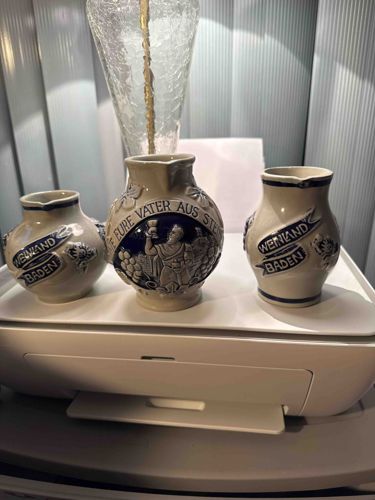
Vintage German Salt-Glazed Westerwald Pitcher and Matching Creamers Set

Antique/Vintage German Stoneware

AI Estimated Value

·Not an official valuation·Verify before acting

$45.00 - $75.00

As of May 27, 2026

AI Item Analysis

·AI can make mistakes·Verify before acting
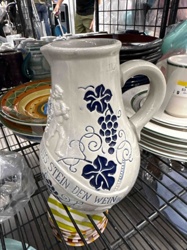
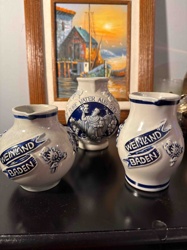
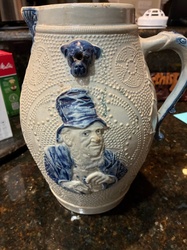
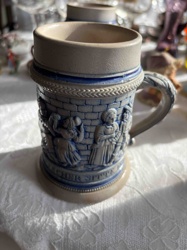
This three-piece set consists of a central serving pitcher flanked by two smaller jugs or creamers, all crafted in the traditional Westerwald style of German stoneware. The central vessel features a spherical body with a flared rim and a pouring spout, decorated with a high-relief central medallion. The medallion depicts a jovial figure holding a drinking vessel, surrounded by a cobalt blue background and the German text 'EURE VATER AUS STEIN,' which translates to 'Your fathers from stone.' The two smaller vessels feature banners reading 'WEINLAND BADEN' (Wine Country Baden), indicating a regional association with the Baden wine-growing area of Germany. Structurally, the items are made of salt-glazed ceramic with a characteristic greyish-beige body and deep cobalt blue accents. The relief work is sharp, featuring floral patterns and vine motifs that signify traditional craftsmanship. The condition appears fair to good; there is some visible surface dirt and potential light crazing consistent with age, though no major cracks or structural repairs are immediately apparent. These pieces likely date from the mid-20th century (c. 1950s-1970s) and represent typical souvenir or household pottery from the Rhineland-Palatinate region, known for high-quality salt-glaze techniques.
AI Appraisal Report

·AI can make mistakes·Verify before acting
I have virtually examined this three-piece German salt-glazed stoneware set. Based on the cobalt-on-grey 'Westerwald' style, relief medallions, and specific typography, I identify these as mid-20th-century souvenir or household production pieces rather than true antiques. The inscription 'WEINLAND BADEN' suggests a regional commemorative origin, likely from the 1950s to the 1970s. The sharp relief work and characteristic 'orange-peel' texture of the salt glaze appear consistent with authentic Rhineland-Palatinate manufacturing techniques of that era. Market demand for mid-century German stoneware is currently stable but modest. These items were produced in high volumes for the tourism and giftware markets, which limits their rarity. Authenticity as decorative stoneware is high, but they lack the maker's marks or intricate hallmarks of prestigious 19th-century firms like Reinhold Hanke or Villeroy & Boch, which prevents them from reaching the premium price tier. The fair-to-good condition—noting surface grime and minor crazing—is standard for utilitarian ceramics of this age. Important Note: This appraisal is based solely on digital images. Without a physical inspection, I cannot rule out the presence of hairline fractures, professional repairs, or base chips that would significantly decrease the value. A full authentication would require an in-person examination to verify the 'ring' of the ceramic (to check structural integrity), high-resolution inspection of the base for incised model numbers or logos, and provenance documentation to confirm the specific manufacturer. For insurance purposes, I recommend cleaning the pieces with a pH-neutral solution to better assess surface wear.

Get your items appraised

Instant estimates of your treasures with AI-powered appraisals

Browse More Appraisals