These notes were written by the person who submitted this item. Appraiser.AI has not verified them, and the AI's identification and estimate may rely on them.
AI Estimated Value
Not an official valuation
$800 - $1,500
AI estimate as of November 23, 2025 · verify with a professional before acting
AI-Generated · Verify before acting
Everything on this page is generated by AI for informational purposes only. AI can make mistakes — the AI may misidentify items or misattribute them (artist, maker, brand, designer, origin, era). This is not an official valuation and should not be used for insurance, sale, tax, estate, legal, or lending purposes — or any decision requiring a certified appraisal. It is not an authoritative claim about any person, brand, or rights holder — do not share or rely on it as a factual statement about a third party. Always consult qualified professionals before making financial decisions.
This analysis also relies on unverified notes provided by the user, which may be incomplete or inaccurate and could affect the result.
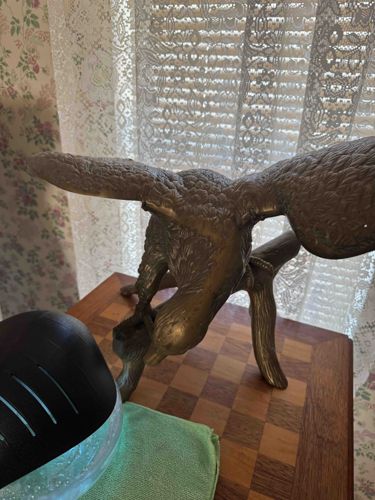
This is a substantial bronze sculpture depicting an eagle perched on what appears to be a stylized branch or rock formation. The material is a dark, aged bronze, exhibiting a rich, warm patina characteristic of older metalwork, with some areas appearing slightly lighter due to wear or polishing. The eagle's wings are spread wide, though only one is fully visible, showing individual feather details meticulously rendered. The texture of the feathers is quite pronounced, suggesting a high level of craftsmanship in the casting. The eagle's body is robust, and it appears to be in a dynamic, possibly predatory or alert, pose with its head lowered. The talons are gripping the support structure firmly. While specific dimensions are not fully discernible from the image, the provided context mentions a weight of 20-25 pounds, indicating a significant size and solid construction, likely cast in bronze using the lost-wax method. There are no visible maker's marks or signatures in the provided views. The overall aesthetic suggests a traditional, possibly neoclassical, or early 20th-century decorative art style, often associated with patriotic or majestic themes. The condition appears good with an appropriate age-related patina; no obvious damage such as cracks or breaks is visible. The piece is resting on a wooden surface that resembles a chessboard, providing a scale reference.
AI Appraisal Report
Upon my virtual examination of this substantial bronze eagle sculpture, I observe a piece exhibiting considerable craftsmanship and presence. The dark, aged patina is consistent with genuine antique bronze, suggesting its age. The meticulous rendering of the individual feathers and the dynamic pose, with wings spread and head lowered, indicate a skilled hand in its creation. The estimated weight of 20-25 pounds aligns with a solid casting, likely employing the lost-wax method, typical for quality bronzes of this scale. The overall aesthetic points to a traditional decorative art style, commonly seen from the late 19th to early 20th century, often associated with patriotic or majestic themes.
Condition appears good; the patina is appropriate for its presumed age, and I detect no visible damage such as cracks or significant repairs from the provided image. The firm grip of the talons on the support suggests structural integrity.
Regarding authenticity, the rich patina and detailed casting are encouraging indicators. However, without a physical inspection, definitive authentication is limited. I cannot conclusively determine the exact alloy composition, internal structure (which might reveal casting methods more definitively), or if any components are later additions. The absence of a visible maker's mark or signature is a factor; while not uncommon for older pieces, its presence would aid in attribution and value. An in-person examination would allow for tactile assessment of surface irregularities, patina consistency, and a search for any faint, obscured marks. Scientific testing, such as XRF analysis, could confirm the bronze composition and age.
In terms of market conditions, large-scale bronze animal sculptures, particularly eagles, generally maintain a steady demand, appealing to collectors of neoclassical, patriotic, or wildlife art. Comparables on the secondary market suggest that well-executed, sizable bronze eagles in good condition, even without a known artist, can fetch values in the $800-$1,500 range. Signed pieces or those with documented provenance from a renowned foundry would command significantly higher prices. This piece’s weight and detail are positive factors, but the lack of attribution slightly tempers its top-tier market potential. Its rarity lies more in its quality and size rather than a unique maker. Should a prominent signature be discovered during a physical review, or if its provenance can be established to a reputable foundry, the appraisal value would likely increase substantially.