AI estimate as of November 8, 2025 · verify with a professional before acting
AI-Generated · Verify before acting
Everything on this page is generated by AI for informational purposes only. AI can make mistakes — the AI may misidentify items or misattribute them (artist, maker, brand, designer, origin, era). This is not an official valuation and should not be used for insurance, sale, tax, estate, legal, or lending purposes — or any decision requiring a certified appraisal. It is not an authoritative claim about any person, brand, or rights holder — do not share or rely on it as a factual statement about a third party. Always consult qualified professionals before making financial decisions.
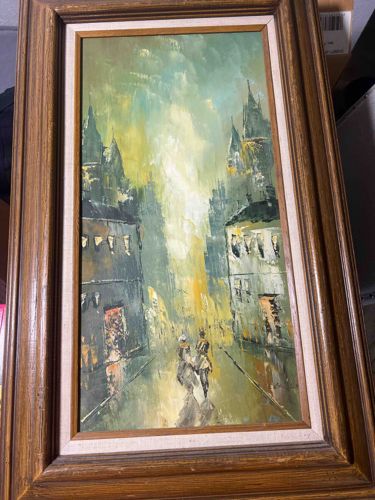
This item is an original oil painting depicting an impressionistic cityscape, likely executed in the mid-20th century. The painting features a narrow street scene flanked by tall, architecturally ambiguous buildings that suggest a European setting, possibly Paris or a similar metropolitan area. The color palette is dominated by muted greens, grays, and yellows, with bright highlights of white suggesting light sources, possibly streetlights or a break in cloudy skies. The brushstrokes are loose, thick, and highly textured, indicative of a palette knife technique or heavy impasto, creating a dynamic and atmospheric quality. Two indistinct figures are visible in the foreground, walking away from the viewer down the illuminated street, adding a sense of scale and narrative. The overall style points to a Mid-Century Modern aesthetic, characterized by abstract tendencies within a representational subject. The painting is housed in a substantial wooden frame with a rustic, dark brown finish and a visible grain. The frame features a slight bevel on its inner edge and an off-white linen or similar fabric liner, which provides a clean separation between the artwork and the outer frame. There are no visible artist's signatures or marks immediately discernible from the image. The frame shows some signs of wear, including minor scuffs and nicks consistent with age and handling. The painting itself appears to be in good condition, with no obvious cracks, paint loss, or significant damage, though a closer inspection would be needed to confirm this. The craftsmanship of both the painting, with its expressive brushwork, and the solid wooden frame suggest a piece of quality, likely mass-produced for the decorative art market of its era or a work by an emerging artist.
AI Appraisal Report
Based on my visual examination of the provided image, this Mid-Century Modern Impressionistic Cityscape Oil Painting appears to be in good overall condition. The paint surface shows no evident cracking or significant loss, and the colors retain their vibrancy. The loose, impasto brushwork, suggesting palette knife technique, is characteristic of the period and adds significant visual interest. The substantial wooden frame with its linen liner also contributes positively to its presentation. Authenticity-wise, without visible signatures or marks, it's challenging to attribute to a specific artist from an image alone. Many such decorative yet well-executed pieces were produced during the mid-20th century, often by studio artists or for the burgeoning decorative art market. This limits its rarity to some extent; while it's an original oil painting, it likely isn't a unique piece by a highly sought-after master. Current market conditions for unsigned mid-century decorative art of this quality are stable, with demand relying on aesthetic appeal rather than artist provenance. Comparable sales for similar unsigned, well-framed impressionistic cityscapes from this era typically fall within the $200-$500 range, depending heavily on visual impact and condition. The lack of a signature significantly impacts its value, as it prevents attribution to a known artist. For full authentication and to potentially identify an artist, an in-person examination for hidden signatures or labels, scientific analysis of materials, and extensive provenance documentation (e.g., gallery labels, exhibition history) would be crucial.