AI estimate as of August 31, 2025 · verify with a professional before acting
AI-Generated · Verify before acting
Everything on this page is generated by AI for informational purposes only. AI can make mistakes — the AI may misidentify items or misattribute them (artist, maker, brand, designer, origin, era). This is not an official valuation and should not be used for insurance, sale, tax, estate, legal, or lending purposes — or any decision requiring a certified appraisal. It is not an authoritative claim about any person, brand, or rights holder — do not share or rely on it as a factual statement about a third party. Always consult qualified professionals before making financial decisions.
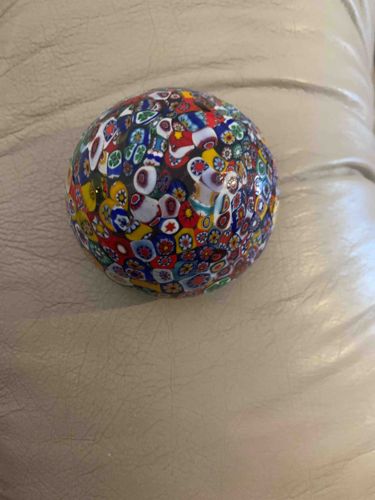
This item is a spherical Murano glass paperweight, characterized by its vibrant and intricate millefiori design. The paperweight is composed of a multitude of small, colorful glass canes (murrine) fused together and encased within a clear glass outer layer, giving it a smooth, glossy finish. The murrine display a wide array of patterns, including floral motifs, stars, concentric circles, and geometric shapes, in a rich palette of red, yellow, blue, green, white, black, and orange. The patterns are distributed densely throughout the spherical form, creating a mosaic-like appearance. The craftsmanship suggests a high level of skill in glassblowing and lampworking, indicative of traditional Murano glass artistry. The surface appears smooth and free from significant scratches or chips, indicating good preservation. There are no visible chips, cracks, or significant abrasions on the exterior. The colors retain their vibrancy, suggesting protection from excessive light exposure. The overall quality and detail of the millefiori canes point to a well-executed piece, likely from the mid-20th century or later, a period when Murano glass art experienced a resurgence in popularity and innovation. No specific maker's marks or signatures are visible in the provided images, which is common for many paperweights of this type, though some may have subtle pontil marks or engraved signatures on the base (not visible here). The reflective nature of the glass suggests a solid, well-polished surface.
AI Appraisal Report
Based on my visual examination of the provided image, this Murano Millefiori Glass Paperweight presents in excellent condition. The surface appears remarkably smooth and clean, devoid of any visible chips, cracks, or significant abrasions. The vibrancy of the colors within the murrine is striking, suggesting good preservation and limited exposure to detrimental light. The intricate patterns, including floral motifs, stars, and geometric shapes, are indicative of skilled Murano craftsmanship.
From the image alone, I assess this paperweight to be an authentic Murano piece, likely dating from the mid to late 20th century. My assessment of authenticity is based on the characteristic millefiori cane work, the typical Murano color palette, and the overall quality of glass artistry evident. The density and variety of the murrine designs are consistent with well-regarded Murano production.
Regarding market conditions, similarly sized Murano millefiori paperweights are readily available, creating a competitive market. Demand for such pieces remains steady among collectors of glass art and decorative objects, but it is not considered rare. Factors that significantly impact value include the complexity and rarity of the murrine patterns, the overall size of the paperweight, and the presence of a clear maker's mark or signature. This piece, while well-executed, features commonly seen patterns and is of a standard size, which places it in the upper-mid range for unsigned pieces.
It is crucial to note the limitations of authentication solely from images. A definitive authentication would require an in-person examination to inspect the pontil mark, search for subtle engraved signatures or original labels, and assess the weight and feel of the glass. While the image suggests a solid form, a physical inspection could confirm this. Provenance documentation, though rarely available for common paperweights, would also enhance certainty. Scientific testing for glass composition is generally not undertaken for items in this price range but could confirm origin if ever disputed.