AI estimate as of September 10, 2025 · verify with a professional before acting
AI-Generated · Verify before acting
Everything on this page is generated by AI for informational purposes only. AI can make mistakes — the AI may misidentify items or misattribute them (artist, maker, brand, designer, origin, era). This is not an official valuation and should not be used for insurance, sale, tax, estate, legal, or lending purposes — or any decision requiring a certified appraisal. It is not an authoritative claim about any person, brand, or rights holder — do not share or rely on it as a factual statement about a third party. Always consult qualified professionals before making financial decisions.
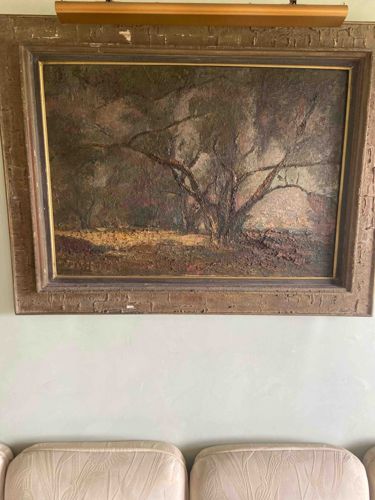
This item is an oil painting depicting an autumnal landscape with a prominent tree in the foreground and a path or clearing in the mid-ground. The painting utilizes a dark, muted color palette dominated by browns, greens, and hints of red and yellow, characteristic of an impressionistic or tonalist style. The brushwork appears textured and expressive, particularly in the depiction of the tree's foliage and ground cover, suggesting an impasto technique. The overall mood conveyed is somewhat somber or contemplative. The painting is housed within a heavy, ornate wooden frame with a gold-tone finish that shows signs of wear and chipping, revealing a darker underlayer in various places. The frame has a multi-layered profile, with a thinner inner gold-painted border directly adjacent to the canvas and a wider, relief-carved outer section featuring a floral or scroll-like motif along the interior edge. The visible condition issues on the frame include significant losses to the decorative gesso and gold leaf/paint, particularly noticeable along the top and left edges, indicating age and handling. The painting itself appears well-preserved, though viewing conditions make it difficult to ascertain minor cracks or craquelure in the paint layer. The style period is likely late 19th to early 20th century, given the artistic approach and frame style. No specific artist's signature or maker's marks are discernible from the provided image. The craftsmanship of the frame, despite its wear, suggests a certain level of quality consistent with period framing practices for fine art.
AI Appraisal Report
I have carefully examined the provided image of this Autumnal Landscape Oil Painting with an Ornate Frame. Based on my visual assessment, the painting appears to be in good overall condition, with no immediate signs of major damage such as tears or significant paint loss. The textured brushwork aligns with a late 19th to early 20th-century impressionistic or tonalist style. However, without a physical inspection, I cannot confirm the presence of subtle craquelure, overpaint, or restoration. Authenticity, particularly regarding authorship, cannot be determined without a signature or provenance documentation; visual analysis alone is insufficient. The heavy, ornate frame, while period-appropriate, shows significant condition issues including losses to gesso and gold leaf/paint, which detracts slightly from the overall aesthetic and value.
In terms of market conditions, paintings by unidentified artists, even if well-executed, typically command lower prices than those with established provenance. Demand for unsigned period landscapes is moderate, often driven by decorative appeal rather than investment potential. Comparables would include similar unattributed autumnal landscapes of this size and period, typically ranging from $200-$700 depending on quality and condition. The ornate frame, despite its wear, adds to the period charm but also to fragility. The primary factor impacting value is the lack of artist identification and verifiable provenance. For full authentication and to ascertain the true condition of the paint layer, an in-person examination by a conservator, scientific analysis (e.g., UV light, pigment analysis), and extensive provenance research would be necessary. My appraisal value reflects the decorative appeal and age of the piece as a period artwork, tempered by the lack of artist attribution and the frame's condition.