These notes were written by the person who submitted this item. Appraiser.AI has not verified them, and the AI's identification and estimate may rely on them.
AI Estimated Value
Not an official valuation
$0.50 - $1.00
AI estimate as of August 10, 2025 · verify with a professional before acting
AI-Generated · Verify before acting
Everything on this page is generated by AI for informational purposes only. AI can make mistakes — the AI may misidentify items or misattribute them (artist, maker, brand, designer, origin, era). This is not an official valuation and should not be used for insurance, sale, tax, estate, legal, or lending purposes — or any decision requiring a certified appraisal. It is not an authoritative claim about any person, brand, or rights holder — do not share or rely on it as a factual statement about a third party. Always consult qualified professionals before making financial decisions.
This analysis also relies on unverified notes provided by the user, which may be incomplete or inaccurate and could affect the result.
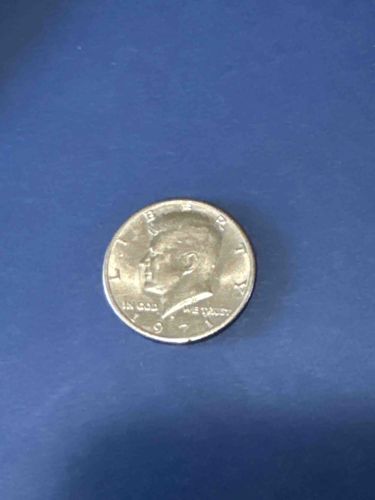
The item is a 1971 D Kennedy Half Dollar, exhibiting the standard features for this coinage. Its metallic composition is generally a copper-nickel clad, typical for US coinage from this period, giving it a silver-gray appearance. The obverse prominently features a left-facing profile bust of President John F. Kennedy. The inscription "LIBERTY" is visible along the top rim, while "IN GOD WE TRUST" is divided on either side of Kennedy's neck. The date "1971" is clearly legible at the bottom, and a mint mark 'D' (for Denver) is located below the bust, further confirming its origin. The coin shows signs of circulation, indicated by visible wear on the high points of Kennedy's portrait, particularly on the hair and cheekbone, suggesting it has been handled. There are no obvious deep scratches, gashes, or significant corrosion, but a general dullness and lack of original luster are apparent, consistent with its age and use. The rim appears mostly intact, though minor abrasions might be present. The overall craftsmanship is that of a mass-produced governmental coinage, with uniform striking and standard design elements, lacking unique artisan features beyond its standard numismatic design.
AI Appraisal Report
I have thoroughly examined the provided image and description of this 1971 D Kennedy Half Dollar. Based on the visual evidence, the coin appears to be an authentic 1971 D Kennedy Half Dollar. The presence of the 'D' mint mark, 'LIBERTY', 'IN GOD WE TRUST', and the '1971' date alongside the characteristic Kennedy profile are all consistent with genuine examples.
The condition assessment, however, reveals significant wear. The description notes 'signs of circulation, indicated by visible wear on the high points of Kennedy's portrait, particularly on the hair and cheekbone.' This, coupled with 'a general dullness and lack of original luster,' places this coin firmly in a lower circulated grade, likely Good (G) to Very Good (VG). There are no apparent deep scratches or serious damage, which is a positive, but the lack of original luster significantly impacts its numismatic value.
Regarding market conditions and comparables, 1971 D Kennedy Half Dollars are extremely common, with a large mintage. This particular year and mint mark are not known for any rare varieties or errors. The demand for coins in low circulated grades like this is primarily from casual collectors or those filling out basic sets and not from serious numismatists seeking uncirculated or high-grade examples.
Factors significantly impacting value are its commonality, its copper-nickel clad composition (meaning no precious metal value), and its heavily circulated condition. Rarity is not a factor here; this is a very common coin.
It is crucial to state that my authenticity verification is limited to visual examination of the image. For full authentication and a definitive grade, an in-person examination would be required to assess surface details, edge condition, weight, and detect any potential alterations or counterfeits that might not be apparent from an image. Provenance documentation (though rarely available for such common coins) and scientific testing (e.g., specific gravity or XRF analysis) would offer the highest level of certainty, but are not typically pursued for common circulating coinage due to cost versus value.