AI Appraisal Estimate

AI-generated estimates · not official valuations

From the user

What was submitted

Photo and notes provided by the user — not generated by AI

Submitted item photo
Submitted photo · June 16, 2026

User's notes

No additional notes provided.

AI analysis below

AI appraisal

AI analysis & estimate

AI-Generated · Verify before acting

Everything below is generated by AI for informational purposes only. AI can make mistakes — the AI may misidentify items or misattribute them (artist, maker, brand, designer, origin, era). This is not an official valuation and should not be used for insurance, sale, tax, estate, legal, or lending purposes — or any decision requiring a certified appraisal. It is not an authoritative claim about any person, brand, or rights holder — do not share or rely on it as a factual statement about a third party. Always consult qualified professionals before making financial decisions.

Read the full disclaimer

AI Identification

·Not independently authenticated·Verify before acting

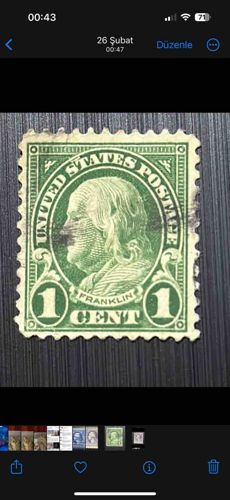
1-Cent Benjamin Franklin Green Postage Stamp

Philately / Postage Stamps

AI Estimated Value

·Not an official valuation·Verify before acting

$0.05 - $0.25

As of June 16, 2026

AI Item Analysis

·AI can make mistakes·Verify before acting
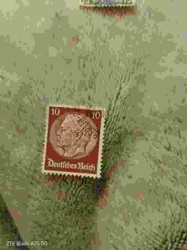
This is a United States postage stamp featuring the profile of Benjamin Franklin, printed in a distinct green ink. Based on the design, it belongs to the Washington-Franklin Issues produced between approximately 1908 and 1922. The stamp features a left-facing bust within an oval frame, flanked by olive branches, with 'UNITED STATES POSTAGE' arched above and '1 CENT 1' below. Physically, the stamp exhibits standard perforations along all four sides, though several teeth appear slightly blunted or irregular. The centering of the printed image is poor, shifted significantly toward the upper-left corner, which is common for this era but reduces collector value. There is a visible black ink cancellation mark, primarily across Franklin's face and the right side of the stamp, indicating it has been through the postal system. The paper shows age-related toning or tanning, particularly along the edges and perforations. The engraving quality is sharp, showcasing the intricate lathe-work typical of Bureau of Engraving and Printing craftsmanship. Determining the exact Scott catalogue number would require physical inspection for watermarks (single or double line 'USPS') and a perforation gauge measurement (likely Perf 11, 12, or 10).

AI Appraisal Report

·AI can make mistakes·Verify before acting
I have examined the digital representation of the 1-Cent Benjamin Franklin green postage stamp, a staple of the Washington-Franklin Issues (1908–1922). Based on the visual evidence, the stamp is an authentic used specimen from a period of high-volume production. The condition is graded as 'Fine' at best, though the centering is significantly 'Off-Center' (OC) toward the upper-left, which heavily detracts from its philatelic appeal. The perforations are present but exhibit bluntness, and the heavy black circular date stamp (CDS) cancellation obscures much of the central vignette. Market conditions for common Washington-Franklin issues are dominated by extreme surplus; hundreds of millions were printed, and used copies with poor centering and heavy cancels hold negligible value for serious collectors. While common varieties like Scott #405 or #498 trade for pennies, certain rare subgroups (such as the Perf 11 #525 or specific watermarked coils) can command premiums. However, without physical inspection, I cannot determine the paper's watermark (single or double line 'USPS') or the exact perforation gauge (e.g., Perf 10, 11, or 12), which are the primary drivers of rarity in this series. A definitive valuation would require an in-person examination using a precision perforation gauge, a watermark detection tray with fluid, and a high-resolution microscopic review of the engraving type. Furthermore, the presence of 'hidden' faults like thins, creases, or repairs can only be identified through tactile handling and back-lit inspection. Barring the discovery of a rare technical sub-type, this remains a common filler-grade specimen.

Get your items appraised

Instant estimates of your treasures with AI-powered appraisals

Browse More Appraisals