These notes were written by the person who submitted this item. Appraiser.AI has not verified them, and the AI's identification and estimate may rely on them.
AI Estimated Value
Not an official valuation
$75-150
AI estimate as of September 2, 2025 · verify with a professional before acting
AI-Generated · Verify before acting
Everything on this page is generated by AI for informational purposes only. AI can make mistakes — the AI may misidentify items or misattribute them (artist, maker, brand, designer, origin, era). This is not an official valuation and should not be used for insurance, sale, tax, estate, legal, or lending purposes — or any decision requiring a certified appraisal. It is not an authoritative claim about any person, brand, or rights holder — do not share or rely on it as a factual statement about a third party. Always consult qualified professionals before making financial decisions.
This analysis also relies on unverified notes provided by the user, which may be incomplete or inaccurate and could affect the result.
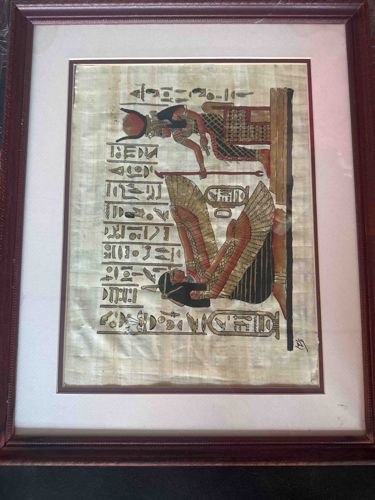
This framed artwork is an Egyptian papyrus piece depicting what appears to be a scene from ancient Egyptian mythology or religious texts. The primary material is papyrus, known for its distinctive horizontal and vertical striations, visible throughout the substrate. The papyrus itself exhibits a light cream to yellowish hue, indicating age or natural discoloration, with visible fibers and slight irregularities characteristic of hand-made papyrus. The artwork is contained within a reddish-brown wooden frame with a subtle grain, featuring a white matboard that provides a clean border around the papyrus. The matboard shows some light discoloration or dust around the edges, suggesting normal wear for being a decor object. The pictorial elements are rendered in various earthy tones, including black for outlines and hieroglyphs, red for details like headwear and clothing accents, and gold or yellow for winged figures and other embellishments. The gold accents, particularly on the wings, give a slight shimmering quality to the piece, enhancing its decorative appeal. The painted figures include a winged deity, likely Isis or Nephthys, with outstretched wings, and another figure, possibly a god such as Ra or Amun-Ra, identifiable by the solar disk and uraeus on its head, positioned above in a ritualistic or divine posture. Hieroglyphic texts are carefully inscribed in vertical columns, filling much of the background and adding to the authenticity of the ancient Egyptian aesthetic. The craftsmanship appears to be of good quality for a commercial reproduction or souvenir piece, with clear lines and consistent color application. The overall condition seems good, with no obvious tears or significant damage to the papyrus, although it is difficult to assess the full extent of its condition through the frame and glass. There are no discernible maker’s marks or signatures visible through the matting, which is common for contemporary papyrus art reproductions. Based on common production methods, this piece is likely a modern reproduction, possibly dating from the late 20th to early 21st century, intended for decorative purposes, reflecting the traditional style of ancient Egyptian art.
AI Appraisal Report
Based on my examination of the provided image, this framed Egyptian papyrus art appears to be a modern reproduction, likely produced in the late 20th to early 21st century for the decorative market. The visible horizontal and vertical striations, along with the light cream hue and slight irregularities, are consistent with contemporary papyrus production. The figures, including a winged deity and a figure with a solar disk, along with the hieroglyphs, are rendered in a style typical of commercial reproductions, with clear lines and consistent color application. The frame and matboard show signs of normal wear, but the overall condition of the papyrus itself seems good with no obvious major damage.
Market conditions indicate a steady but not exceptionally high demand for modern Egyptian papyrus art. These pieces are common souvenirs and decorative items. Comparables in the market, found in online marketplaces and specialty decor stores, typically range from $50 to $200 depending on size, complexity, and framing quality. The lack of maker's marks or provenance documentation is common for such items and supports the assessment of it being a decorative reproduction rather than an ancient artifact.
Factors impacting value include its good condition, appealing subject matter, and reasonable size for display. However, its likely status as a modern reproduction significantly limits its collectible value to that of a decorative item rather than an artifact of historical significance. Given that I have only examined an image, a definitive assessment of authenticity as an ancient artifact is impossible. An in-person examination would be necessary to assess the papyrus fibers, paint composition, and adherence to the substrate more accurately. Microscopic analysis, carbon dating of the papyrus, and pigment analysis would be crucial for establishing genuine antiquity, none of which can be done from an image. Without such testing or compelling provenance documenting ancient origin, it must be appraised as a modern decorative piece.