These notes were written by the person who submitted this item. Appraiser.AI has not verified them, and the AI's identification and estimate may rely on them.
AI Estimated Value
Not an official valuation
$1,800 - $2,800
AI estimate as of November 29, 2025 · verify with a professional before acting
AI-Generated · Verify before acting
Everything on this page is generated by AI for informational purposes only. AI can make mistakes — the AI may misidentify items or misattribute them (artist, maker, brand, designer, origin, era). This is not an official valuation and should not be used for insurance, sale, tax, estate, legal, or lending purposes — or any decision requiring a certified appraisal. It is not an authoritative claim about any person, brand, or rights holder — do not share or rely on it as a factual statement about a third party. Always consult qualified professionals before making financial decisions.
This analysis also relies on unverified notes provided by the user, which may be incomplete or inaccurate and could affect the result.
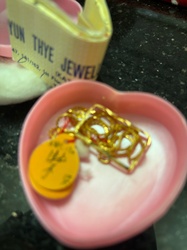
This item is a multi-stone diamond cocktail ring, likely crafted from yellow gold or a similar gold-tone alloy, given its warm, golden hue. The ring exhibits a bold and intricate design, typical of cocktail rings intended to make a significant visual impact. The central cluster of stones appears to be composed of numerous small, round-cut diamonds, arranged in a raised, almost dome-like or inverted pyramid shape, creating a significant sparkle and texture. The diamonds are set closely together, possibly in a pave or cluster setting, to maximize their collective brilliance. Surrounding this central raised cluster, the ring's design incorporates additional smaller diamonds or possibly white topazes, set into what appears to be a broader, geometric-shaped head. The ring's band is visible as a smooth, polished gold tone, forming a substantial base for the elaborate head. The overall construction suggests a solid, well-made piece, although specific material purity (e.g., 10K, 14K, 18K gold) cannot be determined from the image. No specific manufacturing marks or signatures are discernible. The style, with its clustered diamonds and significant presence, suggests an approximate age from the mid-20th century onwards, possibly 1960s-1980s, when cocktail rings were highly popular. The visible condition appears good, with no obvious signs of missing stones or significant damage to the metal, though a professional cleaning might enhance its luster. The craftsmanship demonstrates attention to detail in stone placement and overall design, aiming for a luxurious and eye-catching aesthetic. The piece is designed for formal or special occasion wear, indicative of its 'cocktail ring' classification.
AI Appraisal Report
Upon my virtual examination of this multi-stone diamond cocktail ring, it presents as a striking piece, likely crafted from yellow gold given its warm tone. The central cluster, forming a raised dome of numerous small, round-cut diamonds, is set closely, suggesting a pave or cluster setting designed to maximize collective brilliance and create significant sparkle. The broader head incorporates additional, smaller diamonds, further enhancing its opulent aesthetic. The smooth, polished band appears substantial. Visually, the ring is in good condition, with no obvious missing stones or significant damage.
Authenticity of the diamonds and metal purity cannot be definitively confirmed without in-person examination and testing. However, the design and craftsmanship suggest a well-made piece, consistent with cocktail rings from the mid-20th century onwards (circa 1960s-1980s), a period when such bold styles were highly popular. The aesthetic aligns with general market demand for vintage and estate jewelry, particularly pieces with significant diamond presence.
Factors impacting value include the number and quality of the diamonds (clarity, color, cut, carat weight), which are impossible to ascertain from an image, as well as the karat purity and total weight of the gold. Market comparables for similar vintage diamond cocktail rings, assuming natural diamonds and at least 14K gold, typically range from $1,500 to $3,500, depending heavily on the aforementioned specifics.
For full authentication and a more precise valuation, an in-person examination is crucial. This would allow for diamond testing (to distinguish natural diamonds from simulants or synthetics), grading of diamond characteristics, identification of metal purity through XRF or assay, and a weight measurement. Additionally, microscopic examination could reveal manufacturer's marks or hallmarks, which would further aid in provenance and valuation.