AI estimate as of September 29, 2025 · verify with a professional before acting
AI-Generated · Verify before acting
Everything on this page is generated by AI for informational purposes only. AI can make mistakes — the AI may misidentify items or misattribute them (artist, maker, brand, designer, origin, era). This is not an official valuation and should not be used for insurance, sale, tax, estate, legal, or lending purposes — or any decision requiring a certified appraisal. It is not an authoritative claim about any person, brand, or rights holder — do not share or rely on it as a factual statement about a third party. Always consult qualified professionals before making financial decisions.
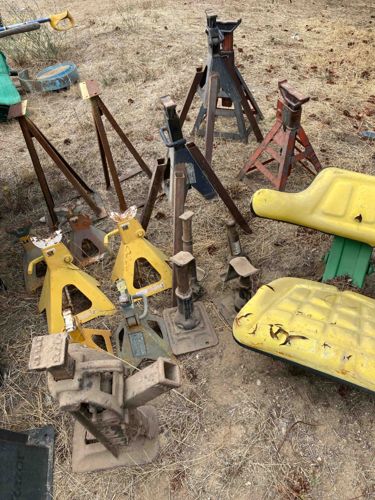
This image displays a collection of automotive jack stands and various other lifting jacks scattered on a dry, grassy, and dirt-covered ground. The predominant items are multiple jack stands, characterized by their sturdy steel construction, typically featuring a wide, stable base with adjustable height mechanisms. Colors vary, including yellow, red, black, and grey/unpainted, indicating different manufacturers or ages. Many stand out with a 'tripod' style base, while some appear to be of a four-legged design. Visible condition issues include significant paint loss, rust, and dirt accumulation, suggesting prolonged outdoor storage or heavy use. Some of the yellow jack stands show substantial chipping and flaking of their original paint. There are also several hydraulic bottle jacks or similar lifting devices, identifiable by their more compact, upright design and square or circular base, some appearing to be a lighter blue-green or unpainted metal. One notably large, older-style jack, possibly a farm jack or a more heavy-duty lifting mechanism, is visible in the foreground with a substantial cast-metal appearance and a squared-off top. The overall condition points to a utilitarian collection that has seen considerable operational use and environmental exposure. No specific manufacturer's marks are clearly discernible from the image, but the variation in design suggests a mix of brands and potential capacities. The items appear to range in age, with some exhibiting more extensive signs of wear and rust than others. The materials are primarily steel and cast iron, designed for robustness and load-bearing applications. The craftsmanship appears functional and industrial, as expected for heavy-duty tools.
AI Appraisal Report
I have examined the provided image depicting an assortment of jack stands and various lifting jacks. The collection consists primarily of multiple jack stands (yellow, red, black, grey) with tripod or four-legged bases, along with several hydraulic bottle jacks and possibly an older, heavy-duty farm-style jack.
Condition-wise, significant wear and tear are evident across the board. There's considerable paint loss, rust, and dirt accumulation, indicating prolonged outdoor exposure or heavy professional use. Some yellow jack stands show substantial chipping and flaking, which, while cosmetic, suggests a lack of recent care or refurbishment. The items appear functional but are in 'used' to 'fair' condition, not 'good' or 'excellent.' Authenticity of manufacturer cannot be verified without closer inspection of labels or stamps; I can only confirm they are indeed automotive lifting equipment.
From a market perspective, these are common utilitarian tools. While essential for vehicle maintenance, the used market for such items is typically robust but driven by low prices. Comparables would include used equipment sold individually or in small lots at auction, garage sales, or online marketplaces. Demand exists, but these are not rare items. The primary factors impacting value are the sheer quantity of items, their functional integrity despite cosmetic flaws, and the general utility for a home mechanic or small repair shop. There is no discerning rarity here.
Limitations in authenticity verification are significant. Without physical inspection, I cannot confirm brand, model, weight capacity, or structural integrity, which are crucial for safety and precise valuation. An in-person examination would allow me to check for cracks, deformation, proper functioning of adjustment mechanisms, and legible manufacturer markings. Provenance documentation would be useful for traceability but highly unlikely for tools of this nature. Scientific testing is not typically applied to used jacks unless there's a suspected failure or material defect warranting a deeper analysis.