These notes were written by the person who submitted this item. Appraiser.AI has not verified them, and the AI's identification and estimate may rely on them.
AI Estimated Value
Not an official valuation
$400 - $700
AI estimate as of September 19, 2026 · verify with a professional before acting
AI-Generated · Verify before acting
Everything on this page is generated by AI for informational purposes only. AI can make mistakes — the AI may misidentify items or misattribute them (artist, maker, brand, designer, origin, era). This is not an official valuation and should not be used for insurance, sale, tax, estate, legal, or lending purposes — or any decision requiring a certified appraisal. It is not an authoritative claim about any person, brand, or rights holder — do not share or rely on it as a factual statement about a third party. Always consult qualified professionals before making financial decisions.
This analysis also relies on unverified notes provided by the user, which may be incomplete or inaccurate and could affect the result.
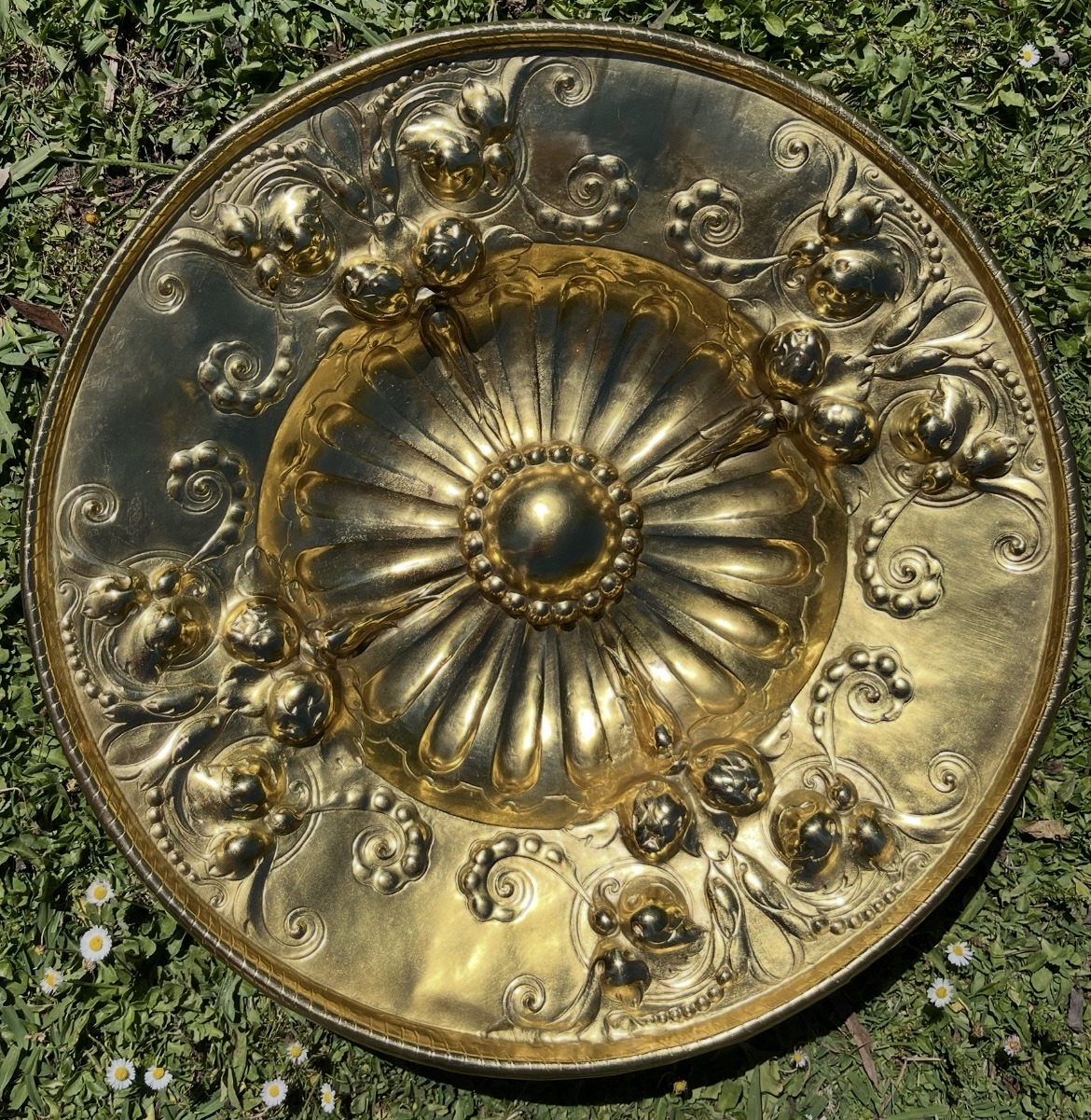
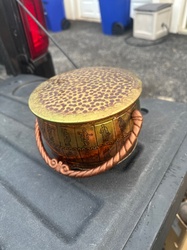
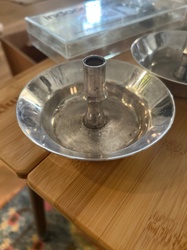
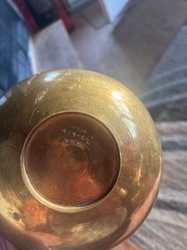
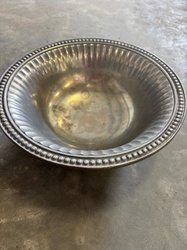
This large circular decorative metal object, photographed resting outdoors on grass, appears to be a heavy brass or brass-plated charger, platter, or wall hanging. Based on the user-supplied context, the item has an approximate diameter of 53 cm and weighs 4.4 kg, indicating substantial heft and thickness. The surface features intricate, highly ornate repoussé and chased craftsmanship executed in a historic revival style, possibly Victorian or Arts and Crafts, though the exact period remains unverified. The central well of the charger displays a convex circular boss encircled by a ring of small beaded repoussé dots, radiating outward into deep, fluted convex lobes that create a dynamic play of light and shadow. The wide outer rim is heavily embellished with elaborate high-relief motifs consisting of swirling acanthus scrolls, volutes, and cluster-like fruit or floral elements interspersed with granulated beadwork. The metal exhibits a bright, polished golden tone with minor surface variations, directional polishing lines, and natural tarnish highlights within the recessed crevices, consistent with aged or cast and hand-chased brass. There is no visible maker's mark, hallmark, or signature apparent on the visible surface shown in the photograph, meaning the identification relies entirely on visual style, form, and technique rather than a confirmed maker. Furthermore, the user-supplied specifications regarding dimensions and weight must be treated as unverified claims until physically measured and inspected. The item shows light surface wear appropriate for display use, but no major structural damage, cracks, or deep gouges are visible from this angle. Quality indicators include the deep relief work, complex symmetry, and significant physical weight, suggesting a piece produced by traditional metalworking techniques rather than lightweight stamping.
AI Appraisal Report
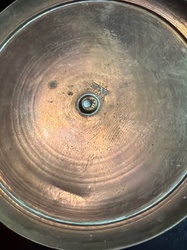
Based on what I can see in the photograph, this large circular decorative metal object appears to be a heavy brass or brass-plated charger featuring intricate repoussé and chased craftsmanship executed in a historic revival style. The owner's unverified specifications indicate a diameter of approximately 53 cm and a substantial weight of 4.4 kg, pointing toward traditional metalworking techniques rather than lightweight stamping. However, I can't verify the exact age, metal composition, or historical period from a photo alone, and physical inspection would be needed to confirm whether the piece is a genuine antique revival work or a later decorative reproduction. The central convex boss, fluted lobes, and wide outer rim embellished with acanthus scrolls and beadwork suggest a visual aesthetic often associated with late 19th-century Arts and Crafts or Victorian domestic metalware. My appraisal estimate of $400 to $700 assumes that the item is a quality period piece consistent with these stylistic markers. General market demand for decorative brass chargers of this scale fluctuates based on interior design trends, and buyers typically value deep relief work and heavy gauge metal. If physical inspection reveals the item to be a modern replica, tourist piece, or executed 'in the style of' a historic period rather than a period example, the value would likely decrease to the $100 to $250 range. To fully determine authenticity and value, an in-person examination by a decorative arts specialist, hallmark verification if any exist on the reverse, and potential metallurgical testing would be required.