These notes were written by the person who submitted this item. Appraiser.AI has not verified them, and the AI's identification and estimate may rely on them.
AI Estimated Value
Not an official valuation
$25-45
AI estimate as of August 12, 2025 · verify with a professional before acting
AI-Generated · Verify before acting
Everything on this page is generated by AI for informational purposes only. AI can make mistakes — the AI may misidentify items or misattribute them (artist, maker, brand, designer, origin, era). This is not an official valuation and should not be used for insurance, sale, tax, estate, legal, or lending purposes — or any decision requiring a certified appraisal. It is not an authoritative claim about any person, brand, or rights holder — do not share or rely on it as a factual statement about a third party. Always consult qualified professionals before making financial decisions.
This analysis also relies on unverified notes provided by the user, which may be incomplete or inaccurate and could affect the result.
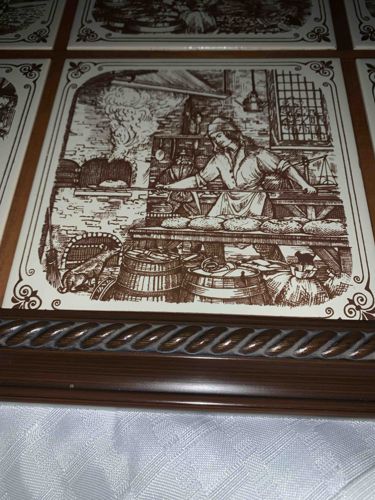
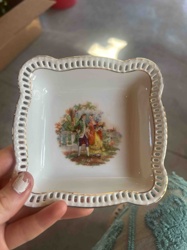
This item is part of a larger set, likely a framed multi-tile panel or trivet, featuring a single ceramic tile depicting a detailed genre scene. The tile is square or rectangular, prominently displaying an \"Old Dutch\" style illustration in sepia-toned brown on a creamy white or off-white background. The central image focuses on a baker tending to an oven and freshly baked loaves of bread on a table, with visible smoke emanating from the oven, suggesting a rustic, traditional setting. Other elements such as wooden barrels, possibly containing flour or water, and implements of baking are also depicted. The artwork style is reminiscent of etching or engraving, characterized by fine lines and cross-hatching to create shading and texture, indicating a transferware or decal application process rather than hand-painting, which allows for consistent reproduction. The tile is framed by a decorative border featuring ornate scrolls and acanthus-like motifs at the corners. The tile itself appears to be in good condition, with no overt chips, cracks, or significant abrasions visible on the ceramic surface or the printed design. The colors are consistent, suggesting good preservation of the pigment. The tile is set into a dark wooden frame, possibly walnut or a stained wood, with a distinctive carved rope-twist or twisted cord pattern along its inner edge, adding a decorative touch. The wood frame exhibits a smooth, glossy finish and appears robust. The overall aesthetic suggests a mid-20th century production, popular for decorative items evoking historical European, particularly Dutch or Flemish, themes. The craftsmanship of the tile itself appears to be of good quality, with clear, sharp details in the print. The framing itself also shows good workmanship, with neat joinery, although the full extent of the framing piece is not visible.
AI Appraisal Report
Upon examining the provided images of this Holland porcelain tile with a baker scene, I can offer the following assessment. The tile itself appears to be a mid-20th-century decorative piece, likely of Dutch or German origin, designed to evoke a historical, rustic aesthetic. The scene is rendered in a sepia-toned transferware print, a common and cost-effective method for this type of decorative ware. The tile appears to be in very good condition, with no visible chips, cracks, or crazing, and the printed image remains sharp and clear. The carved wooden frame, with its distinctive rope-twist inner border, is stylistically appropriate for the period and also appears to be in good condition.
The market for such decorative tiles is generally modest. These items were produced in large quantities and are not considered rare. Their value lies primarily in their decorative appeal rather than any historical significance or particular manufacturer's prestige. Comparable single decorative tiles from this era typically sell at auction or on secondary markets for low prices. The quality of the frame adds some value, but the overall desirability for this specific style is niche.
While the item appears authentic to its type and period, a definitive assessment of origin requires in-person examination. This would allow me to inspect for a manufacturer's mark on the reverse of the tile (e.g., 'Made in Holland' or a specific factory mark) and to assess the true condition of the glaze and frame. Without physical inspection or markings, attribution to a specific 'Holland' manufacturer is speculative.