AI estimate as of August 28, 2025 · verify with a professional before acting
AI-Generated · Verify before acting
Everything on this page is generated by AI for informational purposes only. AI can make mistakes — the AI may misidentify items or misattribute them (artist, maker, brand, designer, origin, era). This is not an official valuation and should not be used for insurance, sale, tax, estate, legal, or lending purposes — or any decision requiring a certified appraisal. It is not an authoritative claim about any person, brand, or rights holder — do not share or rely on it as a factual statement about a third party. Always consult qualified professionals before making financial decisions.
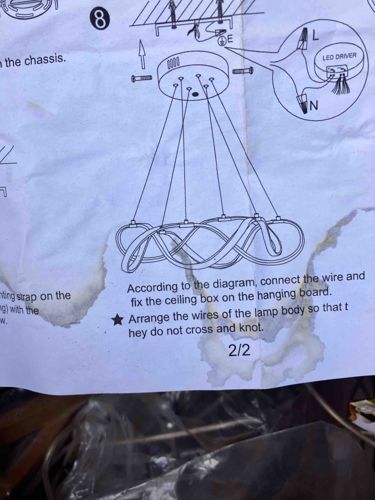
The item depicted is assembly instructions for a modern LED chandelier. The primary visual element is a detailed line drawing illustrating the wiring and installation of the fixture. The chandelier itself appears to feature a design with multiple intertwined or looped elements, forming a complex, sculptural shape at the base, from which several suspension wires extend upwards to a circular ceiling mount. The illustration suggests that the fixture utilizes an LED driver, indicating it is an energy-efficient lighting solution. The visible components include a circular ceiling rose (or canopy) that houses the electrical connections and LED driver, and multiple thin suspension wires or cords that support the main lamp body. The lamp body's design is abstract and contemporary, likely made from metal or a similar durable material with integrated LED strips. The instructions also show connection points for live (L), neutral (N), and ground (E) wires. The documentation is printed on white paper, which exhibits significant water damage or staining, particularly in the lower left and middle right sections, appearing as irregular brown splotches. There's also a crease or fold line visible. The text is printed in black ink. The overall condition of the instruction sheet suggests it has been exposed to moisture, which could indicate the item itself might have also been in a damp environment, although no direct damage to the fixture is shown. The instructions are labeled "2/2", meaning this is the second and final page of the manual.
AI Appraisal Report
Upon examining the provided image of the assembly instructions for this Modern LED Chandelier, my assessment is that the documentation itself is in poor condition due to significant water damage and creasing. This, however, does not directly impact the value of the chandelier itself, only the usability of its included instructions. From the detailed line drawing, the chandelier appears to be a contemporary piece, likely mass-produced, featuring an abstract, sculptural design with integrated LED technology. The presence of an LED driver suggests it's a modern, energy-efficient fixture.
Market conditions for modern LED chandeliers are robust, with a wide range of options available. This specific design, while appealing, does not immediately stand out as unique or high-end designer. Comparables are readily available from various online retailers and big-box home improvement stores, ranging from mid-tier to upper-mid-tier pricing based on size, materials, and design complexity. Demand for modern, energy-efficient lighting is consistently high.
This item is not rare; similar designs are commonly produced by various manufacturers. The primary factors impacting value would be the actual materials used (e.g., aluminum, steel, high-quality acrylic diffusers), the quality of the LED components, and the overall craftsmanship of the fixture. Minor scuffs or scratches are common in new items post-assembly but would slightly reduce value.
Without a direct view of the chandelier itself, my appraisal is purely speculative regarding its physical condition and exact design nuances. The authenticity of the chandelier (i.e., whether it's truly from a reputable manufacturer or a generic copy) cannot be verified from instructions alone. Full authentication would require in-person examination to assess material quality, finish, structural integrity, and the presence of manufacturer markings or certifications. Provenance documentation, such as purchase receipts or manufacturer's warranty, would also be crucial to confirm authenticity and original retail value. Scientific testing, for example, to analyze metal composition or LED specifications, is not typically performed for appraisal unless there are significant concerns about material claims, but it could confirm claims of high-quality components.