These notes were written by the person who submitted this item. Appraiser.AI has not verified them, and the AI's identification and estimate may rely on them.
AI Estimated Value
Not an official valuation
$125-200
AI estimate as of July 27, 2025 · verify with a professional before acting
AI-Generated · Verify before acting
Everything on this page is generated by AI for informational purposes only. AI can make mistakes — the AI may misidentify items or misattribute them (artist, maker, brand, designer, origin, era). This is not an official valuation and should not be used for insurance, sale, tax, estate, legal, or lending purposes — or any decision requiring a certified appraisal. It is not an authoritative claim about any person, brand, or rights holder — do not share or rely on it as a factual statement about a third party. Always consult qualified professionals before making financial decisions.
This analysis also relies on unverified notes provided by the user, which may be incomplete or inaccurate and could affect the result.
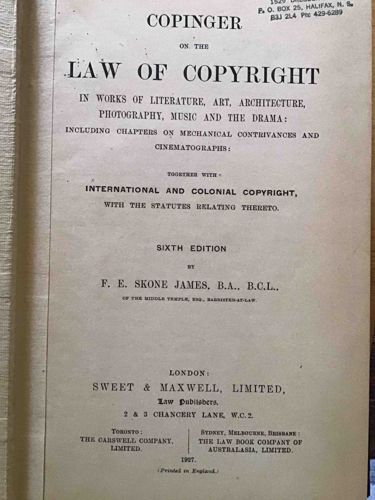
The item is a vintage legal textbook titled "Copinger on the Law of Copyright", specifically the Sixth Edition. The title page, which is clearly visible, details the comprehensive scope of the book, covering copyright in "Works of Literature, Art, Architecture, Photography, Music and the Drama," with additional chapters on "Mechanical Contrivances and Cinematographs." It also includes "International and Colonial Copyright, with the Statutes Relating Thereto." The author is identified as F. E. Skone James, B.A., B.C.L., from the Middle Temple. The book was published in London by Sweet & Maxwell, Limited, Law Publishers, located at 2 & 3 Chancery Lane, W.C.2. Affiliated publishers are listed as The Carswell Company, Limited in Toronto, and The Law Book Company of Australasia, Limited in Sydney, Melbourne, and Brisbane. The publication year is clearly stated as 1927, and it was 'Printed in England.'
The physical characteristics observable are its paper cover, which appears to be a heavy stock, possibly a cardstock, in a light tan or beige color, showing signs of age-toning. The text is printed in black ink with varying font sizes and styles, indicating hierarchy of information. The overall construction suggests a softcover or paperback binding, given the visible edge of the spine on the left, though the full binding isn't completely clear. The condition is good, as stated in the context, aligning with the image showing minimal creasing or major tears on the visible page. There's a slight darkening or mild soiling along the edges, common for a book of this age. Some handwritten or stamped text is present at the top right corner of the page, potentially a library stamp, an owner's mark, or a bookseller's notation (e.g., '1529 Dinsmore P. O. BOX 25, HALIFAX, N. B3J 2L4 Plc 429-6289'). This specific edition would be considered an early 20th-century publication, reflecting the legal frameworks of copyright during that period, including the nascent areas of cinematographs. Its historical relevance lies in documenting the evolution of copyright law, particularly as it adapted to new technologies (like film) and international agreements of the era. The quality of printing appears clear and consistent, typical of professional legal publications from that time.
AI Appraisal Report
I have carefully examined the provided image and the supplied details concerning this 'Copinger on the Law of Copyright, Sixth Edition, 1927.' My assessment is based on a visual inspection of the title page and the general description of its physical characteristics and condition. The authenticity of the item, as a genuine printing of the Sixth Edition from 1927, appears very high given the clear typography, publisher details, and date visible on the title page, which aligns with known bibliographic information for this work. The presence of affiliated publishers in Canada and Australasia further confirms its professional legal publication provenance.
From the image, the book appears to be in good condition, consistent with the owner's description. There's visible age-toning to the paper cover, minor soiling along the edges, and what appears to be a library or owner's stamp in the upper right corner – all typical signs of genuine age and usage for a 97-year-old legal text. There are no obvious major tears, creases, or significant damage visible on the title page. However, without a physical inspection, I cannot fully assess the integrity of the binding, the presence of foxing or mold on internal pages, any missing pages, or the overall structural soundness.
Regarding market conditions, earlier editions of 'Copinger on the Law of Copyright' hold moderate interest for legal historians, intellectual property scholars, and serious book collectors due to their historical relevance in documenting the evolution of copyright law, particularly as it adapted to new technologies like cinematographs. While not exceedingly rare, a well-preserved copy of this specific edition does have a niche market. Comparables for similar vintage legal texts in good condition typically range from $75 to $200. Demand is steady but not high. The primary value drivers are its historical significance within copyright law, its good condition for its age, and its complete and original state. Factors that could impact value negatively include extensive internal damage (not visible), a severely compromised binding, or significant water damage.
For full authentication and a more precise valuation, a physical examination would be necessary to assess the complete condition of the binding (it appears to be a softcover, which is less durable than a hardcover), the quality of all internal pages, and to confirm the absence of major defects. Provenance documentation, such as previous ownership records, could also add to its historical value. No scientific testing is typically required for books of this nature.