AI estimate as of July 3, 2025 · verify with a professional before acting
AI-Generated · Verify before acting
Everything on this page is generated by AI for informational purposes only. AI can make mistakes — the AI may misidentify items or misattribute them (artist, maker, brand, designer, origin, era). This is not an official valuation and should not be used for insurance, sale, tax, estate, legal, or lending purposes — or any decision requiring a certified appraisal. It is not an authoritative claim about any person, brand, or rights holder — do not share or rely on it as a factual statement about a third party. Always consult qualified professionals before making financial decisions.
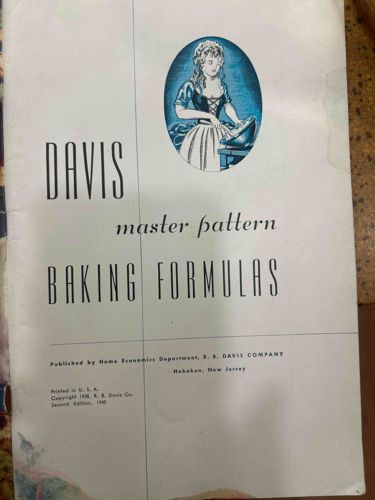
The item is a vintage recipe booklet titled "DAVIS master pattern BAKING FORMULAS." It appears to be a softcover publication, likely made of paper or cardstock, judging by its pliable appearance and visible wear. The dominant colors are off-white for the background and black for the text, with a noticeable teal or turquoise used for an oval-shaped illustration at the top center. This illustration depicts a woman in what appears to be late 18th or early 19th-century attire, actively engaged in baking or food preparation, possibly mixing ingredients in a bowl. The overall aesthetic suggests a historical or retro charm, typical of publications from the early to mid-20th century.
Manufacturing details are discernable from the lower left corner: "Printed in U.S.A.", "Copyright 1938, R. B. Davis Co.", and "Second Edition, 1940." This indicates a publication date of 1940 for this specific edition. It was "Published by Home Economics Department, R. B. DAVIS COMPANY, Hoboken, New Jersey."
Visible condition issues include notable staining and discoloration, particularly along the left edge and in several spots on the right side, suggesting exposure to moisture or age-related foxing. There are also faint vertical and horizontal lines, possibly creases or folds from handling, that span across the entire cover. These imperfections are consistent with the age of the item and its practical use. The craftsmanship appears to be standard for a mass-produced booklet of its era, focusing on clear printing and functional layout over elaborate embellishments. The item's condition suggests it has been used rather than preserved, adding to its authentic vintage character.
AI Appraisal Report
I have examined the image of the 'DAVIS master pattern BAKING FORMULAS (Second Edition, 1940)' recipe booklet. Based on the visual evidence, the authenticity appears high given the clear printing of copyright (1938) and edition (1940), consistent with publications of that era. The 'Printed in U.S.A.' and publisher details (R. B. Davis Co., Hoboken, New Jersey) further support its provenance.
Condition: The booklet is in fair to good condition, consistent with its age and intended use. Visible staining, discoloration, and creasing indicate significant handling and exposure over time. While not pristine, these imperfections contribute to its authentic vintage character rather than detracting significantly from its collectible appeal, given its functional nature as a cookbook.
Market Conditions & Comparables: Vintage cookbooks and recipe booklets, particularly those with historical significance or charming period aesthetics, have a niche but consistent market. Similar baking-related booklets from the 1920s-1950s often sell in the $10-$30 range, with more sought-after or rare items reaching higher. The 'DAVIS master pattern' series is known, but individual editions don't typically command high prices unless they are exceptionally rare or in mint condition.
Demand & Rarity: This Second Edition from 1940 is not considered extremely rare. While collectible, its demand is primarily from enthusiasts of vintage cookbooks, baking history, or specific brand ephemera (R. B. Davis Co.). It presents a charming snapshot of mid-century American home economics. Factors impacting value negatively are the visible wear and the common nature of such promotional booklets. However, its age and completeness as a historical artifact maintain its value.
Limitations: My assessment is based solely on the provided image. A full in-person examination would be necessary to confirm page completeness, internal condition (e.g., presence of odors, internal foxing, tears not visible on the cover), paper quality, and subtle details not discernible from a photograph. Provenance documentation beyond the printed copyright would provide absolute authentication, but is rarely available for such ephemeral items. No scientific testing is typically warranted for this type of item unless significant restoration or forgery is suspected, which is not indicated here.