AI estimate as of August 20, 2025 · verify with a professional before acting
AI-Generated · Verify before acting
Everything on this page is generated by AI for informational purposes only. AI can make mistakes — the AI may misidentify items or misattribute them (artist, maker, brand, designer, origin, era). This is not an official valuation and should not be used for insurance, sale, tax, estate, legal, or lending purposes — or any decision requiring a certified appraisal. It is not an authoritative claim about any person, brand, or rights holder — do not share or rely on it as a factual statement about a third party. Always consult qualified professionals before making financial decisions.
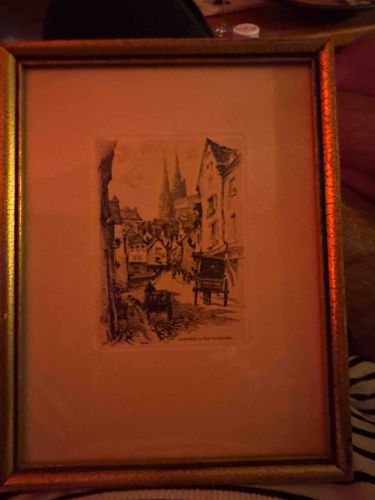
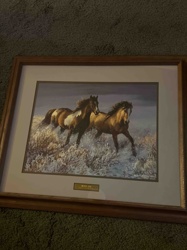
The item is a framed art print depicting a detailed urban street scene. The medium appears to be an ink drawing or etching, characterized by fine lines and strong contrasts in monochromatic tones, likely black ink on off-white or cream paper. The scene features a cobblestone street with buildings lining both sides, exhibiting architectural details such as multiple stories and pitched roofs. In the background, two prominent spires, possibly of a cathedral or large church, rise above the cityscape. The foreground includes human figures, appearing small in scale, possibly walking or engaged in daily activities, and a horse-drawn carriage or cart, suggesting a historical setting. The print is housed within a gold-colored frame, which has a moderately ornate, possibly carved or molded, design running along its inner and outer edges, giving it a classic or traditional aesthetic. The frame itself shows some signs of wear consistent with age, such as minor scuffs or imperfections on its surface. The print is matted, with a wide, light-colored mat board providing a border between the artwork and the frame, enhancing the visual focus on the central image. The overall condition appears to be good for its presumed age, with no visible rips, tears, or significant discoloration to the print itself, although the lighting in the image makes it difficult to assess subtle yellowing or foxing of the paper. This type of detailed cityscape often dates to the late 19th or early to mid-20th century, a period when such illustrative prints were popular. The craftsmanship of the drawing is indicative of a skilled artist, capturing depth and perspective effectively. No clear maker's marks or signatures are discernible from the provided images, which would be crucial for a more precise identification and valuation.
AI Appraisal Report
Upon examining the provided image of this framed urban street scene print with cathedral spires, I assess its condition to be good for its presumed age. The print itself shows no visible rips, tears, or significant discoloration, though subtle yellowing or foxing cannot be definitively ruled out without in-person inspection. The gold-colored frame exhibits minor wear consistent with age, which is expected and does not significantly detract from its aesthetic. The choice of a wide, light-colored mat enhances the artwork effectively.
From a market perspective, detailed cityscape prints, particularly those depicting historical settings and executed with fine linework as seen here, generally find a steady, albeit niche, demand. Comparables based on style and apparent age (late 19th to mid-20th century) typically range in value. Unsigned or unidentified prints, while possessing artistic merit, usually fall into a lower tier compared to those with a known artist or provenance. The lack of discernible maker's marks or signatures is the primary limiting factor in terms of authenticity and valuation. While the craftsmanship is evident, without a signature, artist's estate, or gallery documentation, verifying authenticity beyond a general period and style is impossible from images alone. An in-person examination would allow for closer inspection for hidden marks, paper type, and printing technique, all crucial for full authentication. Provenance documentation, such as sales receipts or exhibition history, would significantly enhance value, as would scientific testing of the paper and ink if dating were a specific concern. Due to these limitations, and based on what can be observed, this piece would appeal more to a general decorative art market than a high-end collector's market.