AI estimate as of July 31, 2025 · verify with a professional before acting
AI-Generated · Verify before acting
Everything on this page is generated by AI for informational purposes only. AI can make mistakes — the AI may misidentify items or misattribute them (artist, maker, brand, designer, origin, era). This is not an official valuation and should not be used for insurance, sale, tax, estate, legal, or lending purposes — or any decision requiring a certified appraisal. It is not an authoritative claim about any person, brand, or rights holder — do not share or rely on it as a factual statement about a third party. Always consult qualified professionals before making financial decisions.
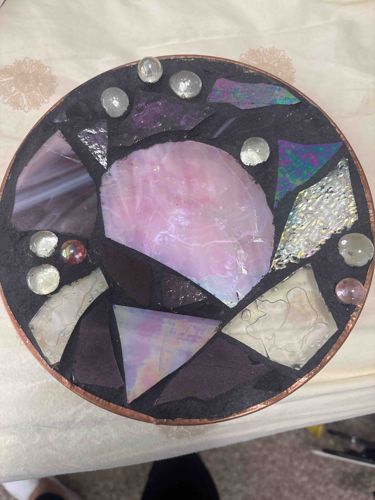
This appears to be a handcrafted mosaic trivet or decorative plaque, circular in shape, with an estimated diameter of 8-10 inches based on typical trivet sizes. The primary materials are various types of glass mosaic pieces and small, clear and colored glass beads or marbles, all set into a dark, likely concrete, grout or plaster base. The overall color palette is dominated by purples, pinks, and iridescent whites, with a prominent central piece of what appears to be a large, polished rose quartz or similar pink translucent stone/glass.
Physical characteristics include a flat, circular form with a slightly raised surface due to the embedded elements. The edges are finished with a copper-toned metal band, suggesting a prepared base or frame. The pieces of glass vary significantly in size, shape, and transparency; some are triangular, others irregular. Notable features include the large central pink element which exhibits slight translucency and internal striations, indicating either natural stone or a highly realistic glass imitation. Several small, clear, rounded glass beads are strategically placed, adding dimensionality and sparkle. One small red/orange bead is also visible. Some white glass pieces show faint, etched patterns or textures within them, adding subtle detail.
Condition-wise, the visible grout appears dark and generally intact, though some very minor surface inconsistencies might be present upon closer inspection. The glass pieces seem well-adhered, and there are no immediately apparent cracks or significant chips in the glass. The copper-colored rim appears to be in good condition, with a uniform patina. There are no discernible maker's marks or signatures visible from the top view. This piece exhibits qualities of folk art or contemporary craft, likely created in the late 20th or early 21st century. The craftsmanship appears competent, with a good overall arrangement of pieces, indicating a thoughtful design.
AI Appraisal Report
Based on my visual examination of the provided image, this circular glass and stone mosaic trivet/plaque appears to be in very good condition. The grout is intact, and the various glass and bead elements seem well-adhered, with no visible chips or cracks. The copper-toned rim also presents well, suggesting a uniformly aged patina. Authenticity, in the sense of attribution to a specific artist or period, is challenging without physical inspection; no maker's marks are discernible. This piece strongly suggests contemporary craft or folk art, likely from the late 20th or early 21st century. Its aesthetic appeal lies in its handcrafted nature and the thoughtful arrangement of materials.
Market conditions for artisan-made decorative items like this are generally steady, particularly for unique, well-executed pieces. Comparables would include other handcrafted mosaic trivets, plaques, or small tabletops found in artisan markets, Etsy, or specialized craft galleries. These typically range from $40 to $150 depending on complexity, size, and material quality. The large central rose quartz-like element, combined with the varied iridescent glass, elevates this piece above simpler examples.
Demand for such decorative items is moderate; they appeal to those seeking unique home accents. Rarity is not a significant factor here, as similar items are produced by many crafters, though this specific design appears unique. Factors impacting value positively include the good condition, the varied and attractive materials (especially the central stone/glass), and the overall competent craftsmanship. The lack of a known artist or provenance prevents it from achieving higher, art-market values.
Limitations in authenticity verification from images alone are significant. I cannot confirm the exact material of the central pink element (natural stone vs. high-quality glass), nor can I inspect the reverse for any hidden marks, hanging hardware, or construction details. A physical examination would allow for tactile assessment of material, grout consistency, and a full inspection for subtle flaws or repairs. Provenance documentation would be necessary to attribute it definitively to a specific artist or workshop, while scientific testing could confirm material composition, particularly of the central element.