AI estimate as of October 21, 2025 · verify with a professional before acting
AI-Generated · Verify before acting
Everything on this page is generated by AI for informational purposes only. AI can make mistakes — the AI may misidentify items or misattribute them (artist, maker, brand, designer, origin, era). This is not an official valuation and should not be used for insurance, sale, tax, estate, legal, or lending purposes — or any decision requiring a certified appraisal. It is not an authoritative claim about any person, brand, or rights holder — do not share or rely on it as a factual statement about a third party. Always consult qualified professionals before making financial decisions.
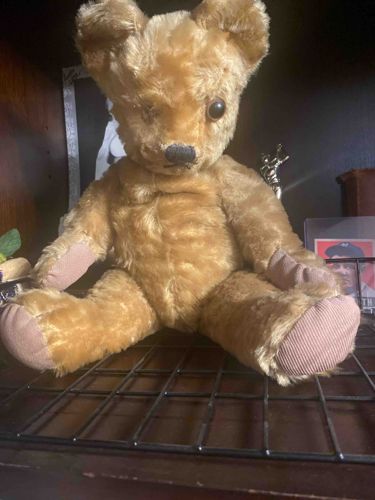
This item is a vintage teddy bear, likely crafted from mohair, given its slightly unruly yet soft-looking texture and characteristic sheen. The bear exhibits an overall golden-brown coloration, consistent with aged mohair. It measures approximately 10-12 inches tall in its seated position, suggesting a total standing height of around 15-18 inches. Notable physical characteristics include round, dark, possibly glass or plastic button eyes, with one eye securely in place and the other visibly missing, leaving a bare patch of stuffing and backing material. The nose is stitched with black thread, appearing in good condition without significant fraying. The mouth area is not distinctly stitched, contributing to a simpler, more classic teddy bear facial expression. The paws and feet are covered with a contrasting lighter brown or tan fabric, possibly corduroy or a similar ribbed textile, which shows a slight difference in texture and wear compared to the main body. The construction appears to be jointed, allowing for articulation of the limbs, although the extent of this articulation (e.g., swivel head, jointed shoulders/hips) cannot be definitively determined from the single image. Visible condition issues include the missing eye, which is the most prominent form of damage. There might be some general surface wear and slight matting of the mohair, consistent with its age and use. There are no obvious tears or repairs visible on the main body. The bear lacks any discernible maker's marks, tags, or signatures in the provided image. Based on its style, particularly the material, button eyes, and general construction, it likely dates from the mid-20th century, possibly the 1940s-1960s. Its unique missing eye adds a degree of character, often appealing to collectors of vintage plush items. The craftsmanship appears to be of good quality, typical of mass-produced yet well-made teddy bears from that era.
AI Appraisal Report
Upon visual examination of the provided image, I assess this vintage teddy bear, likely crafted from mohair, to be in fair, albeit charming, condition. Its golden-brown mohair, button eyes, and general construction point to an authenticity consistent with mid-20th century teddy bears, most probably dating from the 1940s-1960s. The most notable condition issue is the missing left eye, which, while detracting from a "perfect" state, often adds character for some collectors. The remaining eye appears secure, and the stitched nose is intact. There's expected surface wear and slight matting of the mohair typical of its age, but no apparent major tears or repairs. The contrasting paw and foot material shows minor wear.
Market conditions for vintage mohair bears are generally stable, with demand for charming, well-preserved examples. This bear's articulation suggests quality manufacture, although the lack of maker's marks or tags significantly hampers precise identification and thus limits its upper market potential. Without a known manufacturer like Steiff or Ideal, its value falls into a broader category of appealing, unsigned vintage bears. Its rarity is moderate; while not a one-of-a-kind piece, its age and material maintain its collectibility.
Factors significantly impacting its value include the missing eye, which slightly reduces its appeal to purist collectors, and the absence of any identifying marks. A complete bear from an unknown maker would fetch slightly more.
Limitations in authenticity verification are primarily due to the single image. Full authentication would require a physical examination to ascertain joint type, stuffing material, confirm mohair composition (though visually highly probable), and thoroughly search for hidden tags. Provenance documentation could significantly increase value, but this is unavailable. Without these, the appraisal remains an informed estimate based on visual cues.