These notes were written by the person who submitted this item. Appraiser.AI has not verified them, and the AI's identification and estimate may rely on them.
AI Estimated Value
Not an official valuation
$750-1,500
AI estimate as of August 22, 2025 · verify with a professional before acting
AI-Generated · Verify before acting
Everything on this page is generated by AI for informational purposes only. AI can make mistakes — the AI may misidentify items or misattribute them (artist, maker, brand, designer, origin, era). This is not an official valuation and should not be used for insurance, sale, tax, estate, legal, or lending purposes — or any decision requiring a certified appraisal. It is not an authoritative claim about any person, brand, or rights holder — do not share or rely on it as a factual statement about a third party. Always consult qualified professionals before making financial decisions.
This analysis also relies on unverified notes provided by the user, which may be incomplete or inaccurate and could affect the result.
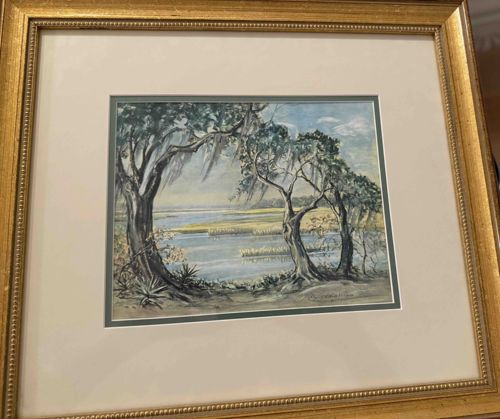
This item is a framed watercolor painting or print depicting a serene Lowcountry marsh scene, likely by Elizabeth O’Neill Verner, given the context. The artwork features two prominent trees, one on the left heavily draped with Spanish moss, framing a vista of a tranquil body of water, possibly an estuary or river, with marsh grasses and distant land visible under a pale blue sky. The color palette is dominated by greens, blues, and muted yellows, typical of such landscapes. The piece is matted with a triple mat system: an inner dark green mat directly bordering the artwork, a wider off-white or cream middle mat, and another subtle green reveal on the outside of the middle mat. The signature 'Elizabeth O'Neill Verner' is discernible in the lower right corner of the artwork, confirming the artist. The entire piece is encased in a substantial gold-painted wooden frame with a beaded inner edge and a textured, possibly gessoed, outer surface, suggesting an ornate and traditional style. The frame appears to be in good condition with minor visible wear consistent with its age, possibly late 19th to mid-20th century, which aligns with Verner's active period. The glass covering the artwork appears clean and free of obvious defects, protecting the work beneath. The craftsmanship of the matting and framing appears professional, enhancing the presentation of the artwork. The overall impression is one of a well-preserved and charming landscape piece.
AI Appraisal Report
Upon examining the provided image and description of this Lowcountry marsh scene, purportedly by Elizabeth O’Neill Verner, I can offer a professional appraisal. The artwork itself, depicting a tranquil marsh scene with Spanish moss-draped trees, is characteristic of Verner’s beloved regional landscapes. The muted palette of greens, blues, and yellows further aligns with her known style. The visual presence of her signature in the lower right corner, if verifiable as original, is a crucial indicator. The triple matting system and the ornate gold-painted wooden frame enhance the presentation significantly; both appear to be in good condition, consistent with the age range of Verner’s active period (late 19th to mid-20th century). The visible wear on the frame is minor and expected. The glass protecting the artwork is clean, suggesting good care.
Regarding condition, based on the image, the painting or print appears to be well-preserved, with no obvious signs of significant damage such as fading, foxing, or tears. The professional framing likely contributed to its preservation.
Market conditions for Elizabeth O’Neill Verner’s work remain stable, with consistent demand for her iconic Lowcountry scenes. Her pieces are highly sought after by collectors with an appreciation for Southern art and regional landscapes. Authenticated watercolors and prints by Verner command strong prices, especially those depicting her signature marsh and architectural themes. Rarity is moderate; while she produced a considerable body of work, high-quality, well-preserved examples are always desirable.
However, it is crucial to state that a definitive authenticity verification beyond visual assessment from an image is limited. While the signature and style are consistent, an in-person examination would be necessary to confirm if this is an original watercolor or a high-quality print. Physical inspection would allow for examination of brushstrokes (for watercolor), paper type, pigment consistency, and any print indications (like dot patterns). Furthermore, provenance documentation (e.g., bills of sale, exhibition history) would significantly bolster authenticity and value. Scientific testing, such as pigment analysis or forensic examination of the signature, could provide absolute certainty. Without these, the appraisal considers the possibility of it being either an original work or a print.
Factors impacting value: The artist's enduring popularity, the appealing subject matter, good condition, and professional framing all contribute positively. The primary variable for value is whether it's an original watercolor (higher value) or a print (lower value). Based on the visual information, it presents as a high-quality piece.