AI estimate as of October 8, 2025 · verify with a professional before acting
AI-Generated · Verify before acting
Everything on this page is generated by AI for informational purposes only. AI can make mistakes — the AI may misidentify items or misattribute them (artist, maker, brand, designer, origin, era). This is not an official valuation and should not be used for insurance, sale, tax, estate, legal, or lending purposes — or any decision requiring a certified appraisal. It is not an authoritative claim about any person, brand, or rights holder — do not share or rely on it as a factual statement about a third party. Always consult qualified professionals before making financial decisions.
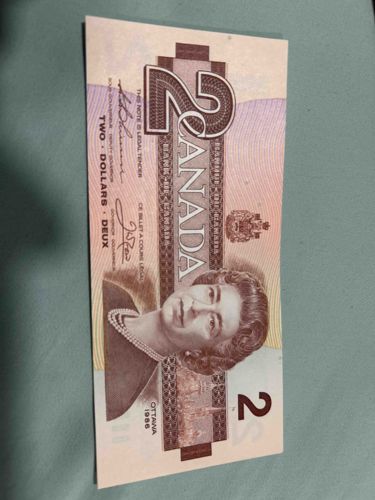
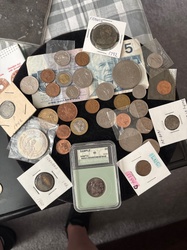
This item is a Canadian two-dollar banknote from the 1986 series, featuring Queen Elizabeth II. The bill is primarily pink and purple in color with dark brown and black printing. Its physical characteristics are consistent with standard paper currency, likely made from a cotton-linen blend paper to ensure durability. The obverse side, visible in the image, displays a prominent portrait of a younger Queen Elizabeth II wearing a pearl necklace, positioned on the right side of the note. To her left, running vertically, is the word "CANADA" in large letters, flanked by patterns. Above the Queen's portrait, the denomination "2" is printed largely. Below her portrait, in smaller text, are the words "OTTAWA" and "1986", indicating the issuing city and year. The left side of the note includes the textual declarations "THIS NOTE IS LEGAL TENDER" and "CE BILLET A COURS LÉGAL", along with the denomination "TWO DOLLARS DEUX". There are also visible signatures, likely of the Governor and Deputy Governor of the Bank of Canada, though their names are not clearly legible. The overall condition appears to be relatively good with some minor handling wear visible, indicated by slight creasing or softening of the paper, but no significant tears, stains, or folds are immediately apparent from this view. The colors are still vibrant, suggesting it has been well-preserved. The design reflects the typical style of Canadian banknotes from the mid-to-late 20th century. No obvious manufacturing defects or unique special markings are discernible beyond the standard elements.
AI Appraisal Report
Based on my visual examination of the provided image, this Canadian two-dollar banknote from the 1986 series, featuring Queen Elizabeth II, appears to be authentic. The design elements, including the portrait of Queen Elizabeth II, the 'CANADA' vertical text, denominational markings, and 'OTTAWA 1986' inscription, are consistent with known specimens of this series. The color palette of pink, purple, dark brown, and black printing also aligns with official issuances. The physical characteristics, as described, suggest a standard cotton-linen blend paper. Crucially, the signatures, although not clearly legible from the image, are present where expected.
Regarding its condition, I assess it as 'Very Fine (VF)' to 'Extremely Fine (EF)'. While there are minor handling wear, indicated by slight creasing or softening of the paper, there are no significant tears, stains, or folds immediately apparent. The colors retain vibrancy, which is a positive sign of its preservation. This condition places it above heavily circulated examples but below uncirculated (crisp, brand-new) notes.
From a market perspective, 1986 series two-dollar bills are relatively common. They were widely produced and remained in circulation for many years, only being replaced by a coin in 1996. Demand for these notes, especially in circulated condition, is generally low among collectors, as a vast supply of higher-grade examples exists. Rarity is not a factor for a standard issue from this series in this condition. Therefore, its market value is not significantly above its face value.
Factors impacting value include the relatively common series and its circulated, though decent, condition. While a crisp, uncirculated example might fetch $10-20, a note in this condition typically trades for a small premium over its face value, primarily as a collectible for beginners or those seeking an example of the series.
It is important to state that this appraisal is based solely on visual inspection of the image. For full and definitive authentication, an in-person examination would be necessary to thoroughly inspect security features such as the watermark, microprinting, and the texture and exact composition of the paper. This would confirm its feel and tactile characteristics, which cannot be assessed from a photograph. Additionally, under UV light, certain security elements would become visible, offering further proof of authenticity. While I am confident this note is genuine based on the image, physical inspection always provides the highest level of certainty.