These notes were written by the person who submitted this item. Appraiser.AI has not verified them, and the AI's identification and estimate may rely on them.
AI Estimated Value
Not an official valuation
$100-200
AI estimate as of September 27, 2025 · verify with a professional before acting
AI-Generated · Verify before acting
Everything on this page is generated by AI for informational purposes only. AI can make mistakes — the AI may misidentify items or misattribute them (artist, maker, brand, designer, origin, era). This is not an official valuation and should not be used for insurance, sale, tax, estate, legal, or lending purposes — or any decision requiring a certified appraisal. It is not an authoritative claim about any person, brand, or rights holder — do not share or rely on it as a factual statement about a third party. Always consult qualified professionals before making financial decisions.
This analysis also relies on unverified notes provided by the user, which may be incomplete or inaccurate and could affect the result.
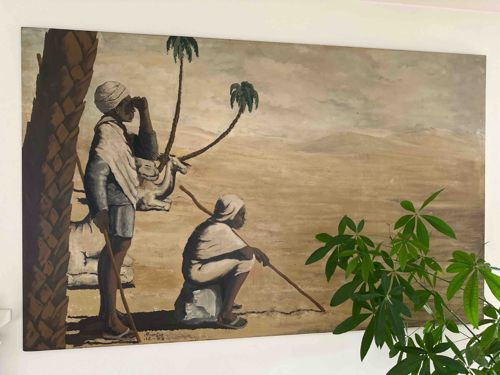
This is a rectangular oil or acrylic painting on what appears to be a canvas or wooden panel, depicting a desert landscape with two figures and two camels. The artwork has a muted color palette dominated by browns, tans, and dull greens, consistent with a desert environment under an overcast or hazy sky. The physical characteristics indicate a medium to large-sized piece, designed to be hung on a wall. The composition features a prominent, textured brown object on the far left, likely a palm tree trunk, framing the scene. Two male figures, dressed in light-colored, possibly white or off-white, traditional African or Middle Eastern attire, are positioned in the foreground. One figure stands, leaning on a staff, and gazes into the distance with a hand raised to shield his eyes. The second figure is seated, also leaning on a staff, looking in the same direction. Behind these figures, two camels are visible, rendered with less detail, suggesting they are part of a caravan or resting. More slender palm trees with curved trunks dot the distant landscape, and subtle mountain ranges are visible on the horizon under a cloudy or dusty sky. The painting exhibits a somewhat naive or folk-art style, characterized by simplified forms and a lack of highly detailed rendering, yet conveying a sense of depth and atmosphere. There are visible brushstrokes, indicating it is a hand-painted original. A signature and date, 'Almeda 12-’88', are discernible in the lower left corner, suggesting it was created in December of 1988. The overall condition appears good, with no obvious signs of significant damage, tears, or repairs visible from the image. The colors seem consistent with their intended appearance, without noticeable fading or discoloration. The edges of the canvas/panel appear clean and well-maintained. The painting evokes traditional African or Middle Eastern themes, particularly nomadic life or desert travel.
AI Appraisal Report
Based on my visual examination of the provided image, this rectangular oil or acrylic painting, signed 'Almeda 12-’88', depicts a desert scene with two figures and two camels. The artwork is executed in a somewhat naive or folk-art style, characterized by simplified forms and visible brushstrokes, indicating a hand-painted original. The color palette is muted, consistent with a desert environment. The condition appears good, with no obvious damage, tears, or significant fading discernible from the image. The inclusion of 'African art' by the owner suggests a thematic connection, but visually, the scene could also represent Middle Eastern desert life.
My assessment of authenticity is limited to the visual data. The signature and date appear consistent with the style. However, without in-person examination, provenance documentation, or scientific testing, absolute authentication of the artist or origin is not possible. Physical inspection would allow for examination of paint layers, canvas/panel construction, and direct comparison with known works by an artist named Almeda, if one exists.
Market conditions for folk art or amateur paintings by lesser-known artists are typically modest. Comparables are often found in local art markets, online platforms for unsigned or emerging artists, or estate sales. Demand is niche; while the theme is appealing, the lack of a known artist or significant artistic movement limits broader appeal and rarity. Factors impacting value include the decorative nature, the good apparent condition, and the subject matter. The folk-art style, while charming, generally fetches lower prices than finely executed works by established artists. Considering this, I appraise this piece in the range of $100-200.