AI estimate as of March 19, 2026 · verify with a professional before acting
AI-Generated · Verify before acting
Everything on this page is generated by AI for informational purposes only. AI can make mistakes — the AI may misidentify items or misattribute them (artist, maker, brand, designer, origin, era). This is not an official valuation and should not be used for insurance, sale, tax, estate, legal, or lending purposes — or any decision requiring a certified appraisal. It is not an authoritative claim about any person, brand, or rights holder — do not share or rely on it as a factual statement about a third party. Always consult qualified professionals before making financial decisions.
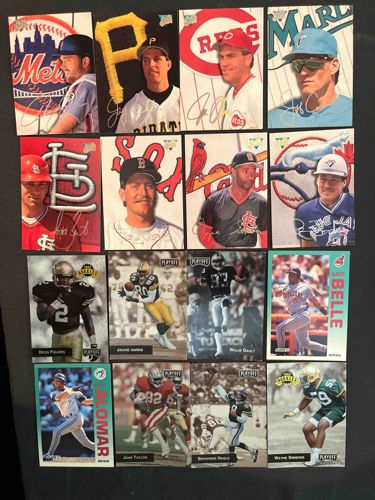
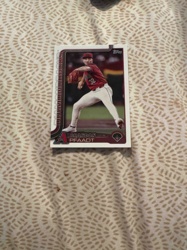
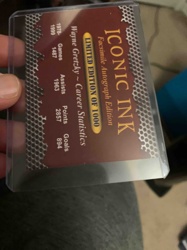
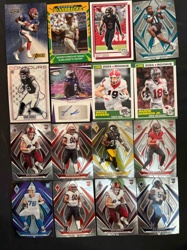
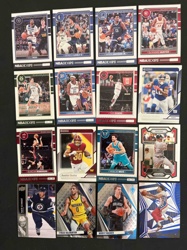
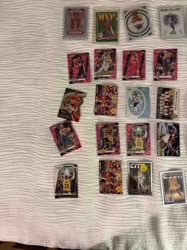
This collection consists of 15 trading cards from the early 1990s, specifically featuring the 1991 Upper Deck Baseball and 1991 Playoff Football series. The top two rows comprise eight Major League Baseball (MLB) cards from the 1991 Upper Deck set, characterized by their high-resolution photography, large background team logos, and gold-stamped facsimile signatures. Featured athletes include notable players across various teams such as the Mets, Pirates, Reds, Marlins, Cardinals, White Sox, and Blue Jays. The bottom two rows feature seven National Football League (NFL) cards, primarily from the 1991 Playoff set, including '1991 Rookies' subsets. Key football players visible include Deion Figures, Jackie Harris, Willie Gault, Albert Belle (multi-sport error/variation context), Roberto Alomar (from the baseball subset), John Taylor, Browning Nagle, and Wayne Simmons.
The cards are standard 2.5 by 3.5 inches, printed on premium glossy white cardstock with a high-finish coating typical of the 'Junk Wax' era's premium releases. Construction quality is high, though condition varies; visible corner softening is present on several cards, and minor surface scratches or edge wear can be seen on the black-bordered Playoff football cards, which are notoriously difficult to maintain in gem-mint condition. There are no obvious signs of moisture damage or major creasing, though the stacking suggests they have been stored raw without individual protective sleeves. The photography displays vibrant colors—reds, blues, and golds are particularly saturated—with sharp registration. These cards represent a peak period of mass production in the sports hobby, where card manufacturers shifted toward high-quality aesthetics but suffered from extremely high print volumes.
AI Appraisal Report
I have conducted a visual examination of this mixed collection of 15 trading cards, consisting of 1991 Upper Deck Baseball and 1991 Playoff Football. The items appear consistent with original production standards of the early 1990s, featuring the hallmark high-gloss finish and gold-foil stamping characteristic of these 'premium' releases. However, the collection's market value is heavily constrained by the 'Junk Wax' era's massive overproduction. During this period, print runs reached the millions, ensuring that supply vastly outstrips modern collector demand.
Condition is the primary value driver for cards of this vintage. Upon inspection, I note several quality issues: visible corner softening on the Upper Deck cards and edge chipping on the black-bordered 1991 Playoff cards, which are notoriously sensitive to handling. Because these appear to have been stored raw (unsleeved), surface micro-scratches are likely present. Most cards in this lot are 'common' players or mid-tier stars like Roberto Alomar; without Gem-Mint 10 grading from a third party like PSA—which these individual cards are unlikely to achieve—they typically retail for $0.25 to $1.00 each.
Limitations of this appraisal: A digital image cannot verify the 'feel' of the cardstock or the presence of subtle trim jobs or artificial recoloring. To provide a definitive authentication, I would require an in-person magnifying loupe inspection (30x) to confirm the halftone four-color printing process and ensure no surface restoration has occurred. Provenance is not required for these specific years due to their low individual cost, but professional grading would be the only way to realize a higher value floor.