AI Appraisal Estimate

AI-generated estimates · not official valuations

From the user

What was submitted

Photo and notes provided by the user — not generated by AI

Submitted item photo
Submitted photo · May 25, 2026

User's notes

No additional notes provided.

AI analysis below

AI appraisal

AI analysis & estimate

AI-Generated · Verify before acting

Everything below is generated by AI for informational purposes only. AI can make mistakes — the AI may misidentify items or misattribute them (artist, maker, brand, designer, origin, era). This is not an official valuation and should not be used for insurance, sale, tax, estate, legal, or lending purposes — or any decision requiring a certified appraisal. It is not an authoritative claim about any person, brand, or rights holder — do not share or rely on it as a factual statement about a third party. Always consult qualified professionals before making financial decisions.

Read the full disclaimer

AI Identification

·Not independently authenticated·Verify before acting

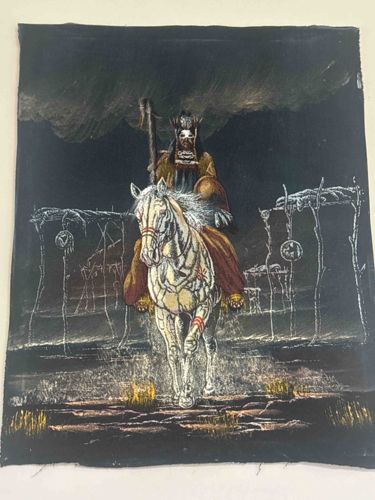
Native American Cultural Painting on Black Velvet

Fine Art - Painting / Folk Art

AI Estimated Value

·Not an official valuation·Verify before acting

$150 - $250

As of May 25, 2026

AI Item Analysis

·AI can make mistakes·Verify before acting
This artwork is a hand-painted scene on a rectangular piece of black velvet fabric, depicting a Native American figure on horseback. The central figure is dressed in traditional regalia, including a ceremonial headdress, face paint, and carrying a staff or personal medicine pole. The white horse is detailed with red war paint markings on its face and legs, and it features an ornate saddle cloth. The background is a moody, dark composition showing burial scaffolds or ceremonial structures under a heavy, clouded moonlit sky. The color palette relies on high contrast, utilizing bright whites, ochre yellows, and deep reds against the light-absorbing black velvet substrate, which creates a dramatic depth and velvet's characteristic sheen. The craftsmanship shows careful attention to the horse's musculature and the intricate details of the rider's attire. The fabric itself shows raw, slightly frayed edges at the bottom, suggesting it was once part of a larger roll or has been removed from a frame. There is no visible artist signature in this view, though such works often date from the 1960s to the 1980s, popularized during the height of the velvet painting movement. The condition appears fair with some minor dust accumulation and light creasing typical of textile art, but with the vibrancy of the pigments largely preserved.


AI Appraisal Report

·AI can make mistakes·Verify before acting
Based on my visual examination of this Native American scene on black velvet, I have assessed the piece as a mid-to-late 20th-century work of folk art. The craftsmanship is notably higher than mass-produced 'souvenir' velvet paintings, demonstrated by the anatomical accuracy of the horse and the delicate application of pigments to create a luminous, atmospheric effect. The use of traditional iconography, such as war paint and burial scaffolds, suggests a commercial artist with a strong grasp of Western/Native American aesthetics popular between 1965 and 1980. The condition is fair; while the pigments remain vibrant, the unfinished, frayed edges and light creasing indicate the painting has been stored unframed, which slightly diminishes the immediate market value. Market demand for velvet art has seen a nostalgic resurgence, though values remain modest compared to oils on canvas. Comparables for unsigned, high-quality kitsch or folk-style velvet works typically fetch between $100 and $300 at specialized auctions. Limitations: Authenticity and age cannot be fully verified via digital image alone. A physical inspection is required to check for artist signatures hidden in the pile, assess the fiber content of the substrate (cotton vs. synthetic), and examine the pigments under UV light for later touch-ups. Provenance regarding the artist's identity would significantly increase rarity and value. Without a signature or clear attribution to a known velvet master like Edgar Leeteg or his contemporaries, the value is based primarily on the decorative quality and subject matter.

Get your items appraised

Instant estimates of your treasures with AI-powered appraisals

Browse More Appraisals