These notes were written by the person who submitted this item. Appraiser.AI has not verified them, and the AI's identification and estimate may rely on them.
AI Estimated Value
Not an official valuation
$2,500 - $4,500
AI estimate as of July 13, 2025 · verify with a professional before acting
AI-Generated · Verify before acting
Everything on this page is generated by AI for informational purposes only. AI can make mistakes — the AI may misidentify items or misattribute them (artist, maker, brand, designer, origin, era). This is not an official valuation and should not be used for insurance, sale, tax, estate, legal, or lending purposes — or any decision requiring a certified appraisal. It is not an authoritative claim about any person, brand, or rights holder — do not share or rely on it as a factual statement about a third party. Always consult qualified professionals before making financial decisions.
This analysis also relies on unverified notes provided by the user, which may be incomplete or inaccurate and could affect the result.
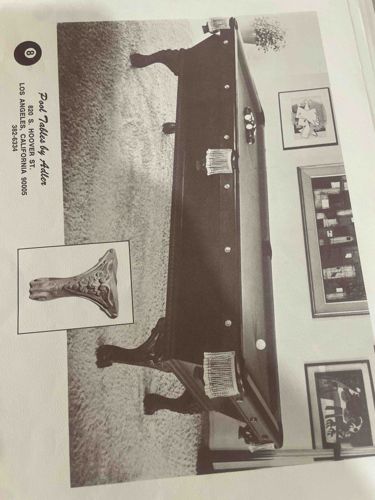
The item is a large, rectangular pool table with a dark finish, likely wood or a wood-like material, possibly oak or mahogany given its classic design. The size is indicated as 5x10, suggesting a professional or oversized billiard table. It features substantial, ornate turned legs, with one leg shown in detail exhibiting intricate carved or cast scrollwork and floral motifs, indicative of a decorative, possibly Late Victorian or early 20th-century style, or a reproduction of such. The table appears to be in good overall condition, with no visible significant damage or wear from the black and white image. The dark finish has a slight sheen, suggesting regular maintenance or a relatively well-preserved surface. The pockets are integrated into the rail, typical of standard pool table construction. The craftsmanship seems high quality, with attention to detail in the leg design. The manufacturing details are provided as "Pool Tables by Adler, 820 S. Hoover St., Los Angeles, California 90005, 382-6334," which suggests a commercial manufacturer, likely from the mid-20th century or later, based on the presence of a telephone number format typical of that era. The visible surface of the table appears to be felted, in a consistent dark tone, contributing to the substantial and robust appearance of the piece. The overall design emphasizes durability and classic aesthetic appeal.
AI Appraisal Report
I have examined the image provided of the Adler 5x10 pool table. Visually, the table appears to be in good overall condition, exhibiting a dark finish and robust, ornate turned legs with significant scrollwork. The 5x10 size indicates a professional or oversized table, which typically commands higher value than standard home tables. The craftsmanship evident in the leg detailing suggests a quality build. The Adler manufacturer details (820 S. Hoover St., Los Angeles, CA 90005, 382-6334) point to a commercial entity, likely operating mid-20th century or later given the telephone number format. This era often produced durable, well-made tables.
From the black and white image, I cannot definitively assess the material (e.g., solid oak, mahogany veneer) or the exact condition of the felt and playing surface beyond a general 'good' assessment. Minor cosmetic flaws, rail wear, or internal structural issues would require in-person inspection.
Market conditions for oversized, well-built vintage pool tables are generally stable. There's a niche demand for these larger tables, often for dedicated game rooms or commercial spaces. Comparables typically include other high-quality vintage tables from manufacturers like Brunswick or Olhausen in similar sizes. Rarity is limited as Adler tables, while not as ubiquitous as Brunswick, were commercially produced. The primary factors impacting value are its size, perceived good condition, and classic aesthetic.
Limitations in authenticity verification are significant. Without physical examination, I cannot confirm materials, structural integrity, or the extent of any hidden damage. Provenance documentation (original sales receipts, previous ownership history) would be crucial for full authentication and understanding its history. Scientific testing, such as wood analysis, would be necessary to confirm specific wood types or finishes if required for a higher-end valuation.