These notes were written by the person who submitted this item. Appraiser.AI has not verified them, and the AI's identification and estimate may rely on them.
AI Estimated Value
Not an official valuation
$50 - $90
AI estimate as of June 30, 2025 · verify with a professional before acting
AI-Generated · Verify before acting
Everything on this page is generated by AI for informational purposes only. AI can make mistakes — the AI may misidentify items or misattribute them (artist, maker, brand, designer, origin, era). This is not an official valuation and should not be used for insurance, sale, tax, estate, legal, or lending purposes — or any decision requiring a certified appraisal. It is not an authoritative claim about any person, brand, or rights holder — do not share or rely on it as a factual statement about a third party. Always consult qualified professionals before making financial decisions.
This analysis also relies on unverified notes provided by the user, which may be incomplete or inaccurate and could affect the result.
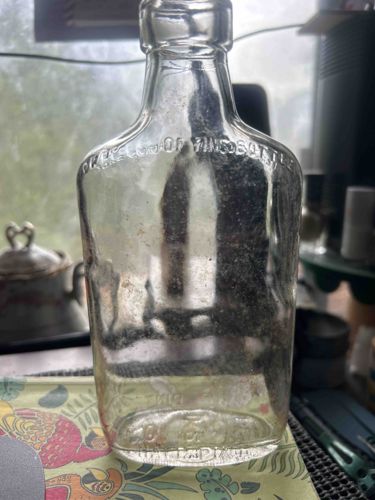
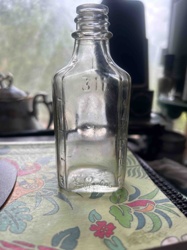
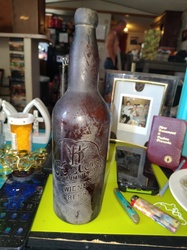
The item presented is a clear, colorless glass bottle, clearly marked as a 'HALF PINT' capacity. Its construction is that of molded glass, resulting in a somewhat rectangular or flask-like body with noticeably rounded corners and gently curving shoulders leading into a relatively short, sturdy neck. The lip of the bottle appears thickened and flared, designed to accommodate a cork or perhaps a universal stopper rather than a threaded screw cap, which is indicative of its manufacturing era. The glass itself appears thick and durable, consistent with utilitarian bottles. The bottle's surface exhibits some minor irregularities and seams typical of its molded production process.
Most notably, the bottle features embossed lettering. Along the upper curvature of the front panel, the phrase "...OF MINNESOTA." is partially visible, strongly suggesting "STATE OF MINNESOTA" – a crucial detail for assessing its origin and purpose. Centrally located on the lower front body, the words "HALF PINT" are clearly and legibly embossed. Additional manufacturing details, as provided, include "10158", "D 23", and "02A" embossed on the base, which are likely mold numbers, plant indicators, or date codes, offering valuable clues to its specific production history.
Regarding its condition, the bottle displays significant internal and external haziness and dirt, giving it a cloudy appearance. This indicates a natural patina from age and exposure rather than recent cleaning, but no major structural damage such as chips, cracks, or breaks are apparent from the provided images. Minor surface abrasions, consistent with an older item, may be present. This type of heavy, embossed glass bottle, particularly one bearing a state name and specific capacity, falls within the early to mid-20th century, likely dating from or shortly after the Prohibition era (1920s-1930s), when state liquor control boards often mandated or distributed such containers. Its primary value lies in its historical context and regional collectibility.
AI Appraisal Report
Based on my examination of the high-resolution images provided, this 'HALF PINT' clear glass bottle with 'STATE OF MINNESOTA' embossing appears to be an authentic piece dating from the early to mid-20th century, consistent with the era of state-mandated or controlled distribution, possibly tied to post-Prohibition liquor regulations. Its construction, including the molded body, rounded corners, sturdy neck, and thickened, flared lip designed for a cork, all align with production methods of that period. The base markings '10158', 'D 23', and '02A' are typical mold or production codes, reinforcing its authenticity.
While the bottle is structurally sound with no apparent chips, cracks, or breaks, its significant internal and external haziness and dirt are notable. This cloudiness, if simple dirt or film, could be cleaned, potentially enhancing its appeal. However, if it represents 'sick glass' (internal etching or chemical degradation), its aesthetic value is permanently diminished. Market conditions for state-specific embossed bottles are generally strong within regional collecting communities, particularly for historical pieces like this. The 'HALF PINT' capacity, while less common than quarts, still holds collector interest. Its rarity is moderate, as specific state-marked utility bottles are not commonplace. The historical context is a significant value driver.
My assessment is limited as I have not physically inspected the item. Without a direct examination, I cannot definitively confirm its true glass clarity underneath the haze, nor can I detect subtle hairline cracks, internal fractures, or professional repairs. A physical examination would allow for tactile inspection of surface condition, determination of the permanence of the haziness, and a more precise assessment of its structural integrity. Authentication would further benefit from any available provenance documentation.