AI estimate as of October 10, 2025 · verify with a professional before acting
AI-Generated · Verify before acting
Everything on this page is generated by AI for informational purposes only. AI can make mistakes — the AI may misidentify items or misattribute them (artist, maker, brand, designer, origin, era). This is not an official valuation and should not be used for insurance, sale, tax, estate, legal, or lending purposes — or any decision requiring a certified appraisal. It is not an authoritative claim about any person, brand, or rights holder — do not share or rely on it as a factual statement about a third party. Always consult qualified professionals before making financial decisions.
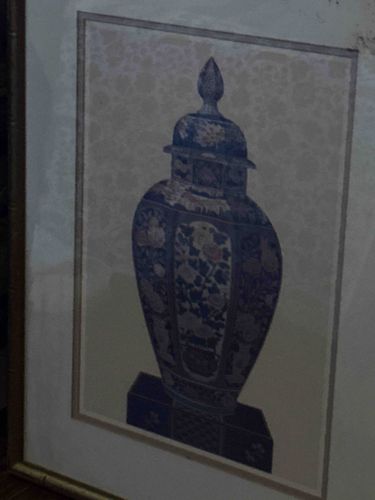
This appears to be a framed print or an artwork depicting a traditional Oriental ginger jar. The jar itself is predominantly dark blue with intricate floral and possibly figural patterns rendered in lighter colors, including what looks like gold, white, and hints of red or pink. The jar has a classic ovoid body, a short, wide neck, and a domed lid topped with a pointed finial. The decorations on the jar are highly detailed, featuring what seem to be various blooming flowers, possibly peonies or chrysanthemums, intermingled with foliage. There are also sections that appear to depict stylized scenes or figures, which is common in traditional Asian ceramics. The ginger jar is depicted resting on a decorative, rectangular stand or plinth, also in a dark color with what might be subtle patterns. The background of the print is a light, neutral tone, possibly cream or beige, with a faint, mottled texture, giving it a somewhat aged appearance. The entire artwork is enclosed within a frame, which has a gold-toned, possibly gilded, inner border, followed by a lighter, off-white mat or inner frame, and then an outer, narrow wooden frame or bezel in a darker, possibly gold-painted or stained, finish. The image quality is somewhat low, making definitive identification of materials difficult, but it strongly suggests a lithograph or similar print. The visible condition issues are minimal due to the nature of a framed print, but there is some dust or minor debris visible on the inner framing components and possibly a slight discoloration or fading consistent with age, or due to the camera's capture. The style and subject matter suggest an antique or vintage reproduction, likely dating from the mid-20th century or later, designed to evoke a classical Asian aesthetic. The craftsmanship refers to the quality of the print and framing, which appear to be standard for decorative art reproductions.
AI Appraisal Report
I have examined the provided image of what appears to be a framed print depicting an Oriental ginger jar. Based on my visual assessment, the item is a decorative reproduction, likely a lithograph or similar print, rather than an original painting. The ginger jar motif, with its dark blue and intricate floral/figural patterns, is a classic Asian aesthetic popular in decorative arts. The framing, including the gold-toned inner border, off-white mat, and darker outer frame, suggests a mass-produced decorative piece.
The condition appears fair, with some visible dust or minor debris within the frame, and potential slight discoloration or fading consistent with age, or typical of photographic reproduction. Authenticity, in terms of it being an original hand-painted artwork, cannot be verified from images alone; however, the lack of visible brushstrokes and the uniformity of the print strongly suggest it is a reproduction.
Market conditions for such decorative prints are generally modest. Comparables would include similar framed reproductions of classical Asian motifs found in home decor stores, online marketplaces, or antique malls. Demand for such items is stable but not particularly high unless associated with a known artist or specific rarity. This particular piece does not exhibit any characteristics suggesting significant rarity.
Factors impacting value include its status as a print rather than an original, the general decorative nature, and the commonality of the subject matter. The primary value lies in its aesthetic contribution as a decorative item.
To definitively authenticate an original artwork, an in-person examination would be required to assess brushwork, paper quality, printing techniques, and potential artist signatures. Provenance documentation, detailing the item's history of ownership and origin, would also be crucial. Scientific testing, such as pigment analysis, would be necessary for a full authentication if there were claims of it being an antique painting. Given the information, my appraisal is based on it being a decorative print.