AI estimate as of August 26, 2025 · verify with a professional before acting
AI-Generated · Verify before acting
Everything on this page is generated by AI for informational purposes only. AI can make mistakes — the AI may misidentify items or misattribute them (artist, maker, brand, designer, origin, era). This is not an official valuation and should not be used for insurance, sale, tax, estate, legal, or lending purposes — or any decision requiring a certified appraisal. It is not an authoritative claim about any person, brand, or rights holder — do not share or rely on it as a factual statement about a third party. Always consult qualified professionals before making financial decisions.
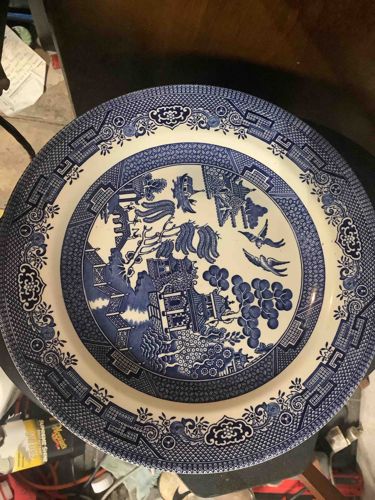
This item is a round dinner plate, likely made of ceramic or stoneware due to its sturdy appearance and classic glaze. Its primary color scheme is a striking blue and white, characteristic of transferware. The central design features the iconic Blue Willow pattern, which depicts a romanticized Chinese landscape with elements such as a pagoda, a bridge, a boat, willow trees, and two doves flying overhead. Two figures are also visible on the bridge. The pattern is intricate and well-defined, showing good craftsmanship in the transfer printing process. The plate has a wide rim, decorated with a repeating border pattern that includes geometric motifs and stylized floral or cloud-like elements, consistent with typical Blue Willow designs. There's an inner border separating the central scene from the rim's pattern, featuring a textured, almost stippled blue design. The glaze appears to be in good condition, with a slight sheen, though without handling, it's hard to ascertain any crazing or minor scratches. No obvious chips, cracks, or significant wear are discernible from the image. The age of the plate is estimable as late 19th to mid-20th century, a period when Blue Willow was immensely popular and widely produced across various potteries. The specific maker's mark is not visible in the provided image, which would be crucial for a precise appraisal. The quality appears to be standard for mass-produced dinnerware of its era, with consistent color application and pattern clarity.
AI Appraisal Report
I have examined the provided image of this Blue Willow Pattern Dinner Plate. Based on its appearance, this is a classic example of transferware, likely ceramic or stoneware. The intricate Blue Willow pattern—featuring the pagoda, bridge, boat, willow trees, and the iconic two doves—is clearly visible and appears well-defined, indicating good craftsmanship for mass-produced dinnerware of its era. The wide rim with its repeating border pattern is also consistent with typical Blue Willow designs.
From the image, the plate appears to be in good overall condition. I observe no obvious chips, cracks, or significant wear. The glaze shows a pleasant sheen, suggesting it is largely intact. However, without a physical examination, I cannot ascertain the presence of minor scratches, crazing, or subtle pattern fading that might impact value.
Regarding authenticity, the pattern itself is hallmark Blue Willow. Given its widespread production, the question isn't typically if it's 'authentic,' but rather by which maker and its specific age. The quality seems standard for late 19th to mid-20th century production. Market conditions for common Blue Willow pattern dinnerware are generally stable but not highly speculative. Individual plates, unless part of a rare full set or from a particularly sought-after factory (like early Spode or Wedgwood), tend to have modest value. Comparables for similar single plates in good condition typically range from $15 to $40. Demand for such pieces is steady among collectors of transferware and blue and white ceramics, but they are not rare.
Key factors impacting value include the lack of a visible maker's mark (which can significantly narrow down age and origin, potentially increasing value), and the inability to physically inspect for damage or wear not apparent in the image. For full authentication and a more precise valuation, a physical examination would be necessary to check for potter's marks, assess surface imperfections (like crazing or utensil marks), and confirm the material. Provenance documentation, if available, would also add value, but is unlikely for common dinnerware.