AI estimate as of October 19, 2025 · verify with a professional before acting
AI-Generated · Verify before acting
Everything on this page is generated by AI for informational purposes only. AI can make mistakes — the AI may misidentify items or misattribute them (artist, maker, brand, designer, origin, era). This is not an official valuation and should not be used for insurance, sale, tax, estate, legal, or lending purposes — or any decision requiring a certified appraisal. It is not an authoritative claim about any person, brand, or rights holder — do not share or rely on it as a factual statement about a third party. Always consult qualified professionals before making financial decisions.
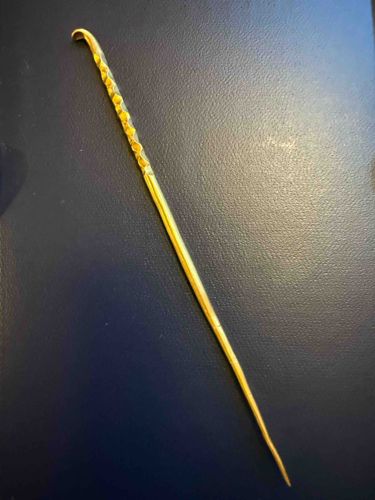
This item is a slender, golden-colored instrument, likely crafted from gold or a gold-plated metal, designed for personal hygiene. It measures approximately 4-5 inches in length, exhibiting a generally straight form with a distinct curve at one end. The material appears to be a polished gold, showing a consistent lustrous yellow hue across its surface. The top section, near the curved end, features a decorative, textured pattern composed of small, irregular indentations or facets that catch the light, creating a shimmering effect. This textured section transitions smoothly into a long, plain, and highly polished shaft that tapers gradually towards a narrow, pointed tip. The curved working end is elegantly rounded and polished, intended to be gentle for its stated purpose. There are no visible maker's marks, signatures, or stamps discernible from the image. The construction appears to be solid, suggesting good craftsmanship despite the lack of direct identification of metal purity. The item shows minimal signs of wear; the polished surfaces are largely unmarred, indicating either careful use, recent cleaning, or a relatively young age. No significant damage, repairs, or heavy patina are visible. This type of personal grooming tool has historical precedent and can be found in various cultures, though without specific markings, its exact age or origin cannot be definitively determined from the image alone. The aesthetic suggests a blend of functionality with a touch of elegance, possibly dating from the late 19th to mid-20th century, or a modern reproduction in a classic style. Its slender profile and golden presentation enhance its perceived quality.
AI Appraisal Report
I have virtually examined this gold-colored personal grooming tool, consistently described as a 'Gold Earwax Spoon/Ear Picker.' Visually, the condition is excellent; the polished surfaces are largely unmarred, suggesting careful use, recent cleaning, or modern craftsmanship. The lustrous yellow hue implies gold or high-quality gold plating. However, its authenticity as solid gold or an antique piece cannot be definitively ascertained without physical examination. The absence of maker's marks is a significant limitation.
Market conditions for such items vary widely. Modern, functional ear picks of good quality can retail for $10-50, while well-documented antique gold pieces can fetch hundreds or even thousands. Without identifying marks or provenance, it's difficult to position this item at the higher end. The design is elegant, merging functionality with aesthetics, which could appeal to collectors of vintage personal grooming items or those seeking boutique modern pieces.
Factors significantly impacting value include the actual metal composition (solid gold vs. plated), age, and origin. If it proves to be solid gold and authentically antique (late 19th to mid-20th century as suggested), its value would increase considerably. Demand for general, unmarked ear picks is low, but for unique or scientifically verified precious metal antiquities, demand is niche but strong.
Limitations are paramount here. To verify authenticity and precise value, an in-person examination is crucial. This would involve specific gravity testing or XRF analysis to confirm metal purity and composition. A thorough physical inspection would also be needed to search for any faint, overlooked hallmarks or construction details that might hint at its age or origin. Documentation of provenance would, of course, provide the most robust authentication, but that is not available here.