These notes were written by the person who submitted this item. Appraiser.AI has not verified them, and the AI's identification and estimate may rely on them.
AI Estimated Value
Not an official valuation
$100-150
AI estimate as of August 23, 2025 · verify with a professional before acting
AI-Generated · Verify before acting
Everything on this page is generated by AI for informational purposes only. AI can make mistakes — the AI may misidentify items or misattribute them (artist, maker, brand, designer, origin, era). This is not an official valuation and should not be used for insurance, sale, tax, estate, legal, or lending purposes — or any decision requiring a certified appraisal. It is not an authoritative claim about any person, brand, or rights holder — do not share or rely on it as a factual statement about a third party. Always consult qualified professionals before making financial decisions.
This analysis also relies on unverified notes provided by the user, which may be incomplete or inaccurate and could affect the result.
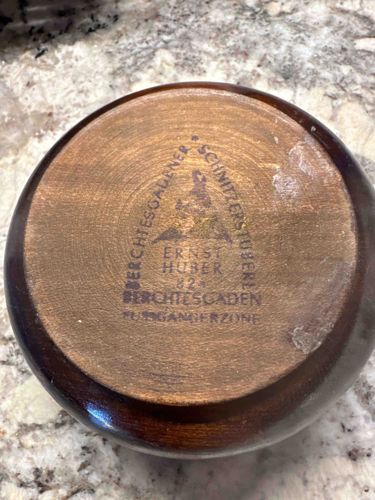
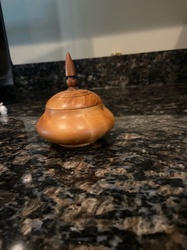
This item is a decorative wooden box or container, likely an early to mid-20th-century piece, crafted by a German artisan. It measures approximately 2.5 inches in height and 5.5 inches in width, suggesting a compact, tabletop utility. The box appears to be made from a dense, dark wood, possibly walnut or a similar hardwood, with a rich, deep brown finish that exhibits a natural luster and a subtle grain pattern. The bottom of the piece reveals a lighter, natural wood tone, contrasting with the polished exterior. A critical feature of this item is the clearly discernible manufacturer's mark on its base. Stamped into the wood, within a circular border, are the words "BERCHTESGADENER SCHNITZERSTUBERE" above a prominent triangular graphic that appears to depict a carved figure or perhaps a stylized mountain, indicating the regional origin of 'Berchtesgaden' in Bavaria, Germany, known for its woodworking traditions. Below this graphic, the name "ERNST HUBER" and the number "82" are visible, suggesting the artisan's name and potentially a model or serial number. Further text "BERCHTESGADEN" and "FUBGANGERZONE" (likely 'FUSGANGERZONE' meaning pedestrian zone) reinforce the geographical context. The craftsmanship suggests a hand-turned or carved piece, given the smooth, simple lines of its form. The finish appears well-preserved, with some minor scuffs or wear marks consistent with age and typical use, particularly around the edges of the base. There are no significant cracks, chips, or repairs visible in the provided image. The presence of a 'removable lid' (as per provided context) implies its function as a container, possibly for trinkets, tobacco, or other small items. The quality of the wood and the clear, well-executed stamping indicate a piece of good, perhaps regional, artisanal quality.
AI Appraisal Report
Upon examining the provided image and details of this Ernst Huber Berchtesgaden wooden box, I assess its overall condition as very good, consistent with its likely age as an early to mid-20th-century piece. The wood, possibly walnut, retains a rich finish with a pleasing luster, and only minor scuffs or wear marks are visible, predominantly on the base edges. There are no apparent cracks, chips, or repairs, which speaks to its careful preservation. The clearly stamped manufacturer's mark, including "BERCHTESGADENER SCHNITZERSTUBERE" and "ERNST HUBER," along with the Berchtesgaden location, provides strong indications of authenticity as a regional artisan piece.
In terms of market conditions, similar regional artisan woodworking from Bavaria, particularly pieces with clear maker's marks, generally appeal to collectors interested in folk art, decorative arts, or specific German regional crafts. While not exceedingly rare, pieces by specific makers like Ernst Huber with such distinct marking can command a modest premium. Demand exists within these niche collecting areas, but it's not a broadly high-demand category like fine art or antique furniture. The box's function as a small container adds to its practical appeal.
Key factors influencing value include its good condition, the clear artisan identification, and its regional origin. The "FUSGANGERZONE" mark, while unusual for a direct artist stamp, likely denotes the location of the workshop within a pedestrian zone, adding to its descriptive charm rather than detracting from value.
It is crucial to note the limitations of authenticity verification from images alone. While the stamps appear consistent with known regional artisan work, a definitive authentication would require in-person examination to verify the wood type, feel the craftsmanship, check for any hidden repairs, and assess the depth and consistency of the stamping. Provenance documentation, such as original sales receipts or family history, would significantly enhance certainty regarding its origin and authorship, though none was provided. Scientific testing, such as dendrochronology (wood dating), would be overly intrusive and unnecessary for an item of this value.