AI estimate as of October 19, 2025 · verify with a professional before acting
AI-Generated · Verify before acting
Everything on this page is generated by AI for informational purposes only. AI can make mistakes — the AI may misidentify items or misattribute them (artist, maker, brand, designer, origin, era). This is not an official valuation and should not be used for insurance, sale, tax, estate, legal, or lending purposes — or any decision requiring a certified appraisal. It is not an authoritative claim about any person, brand, or rights holder — do not share or rely on it as a factual statement about a third party. Always consult qualified professionals before making financial decisions.
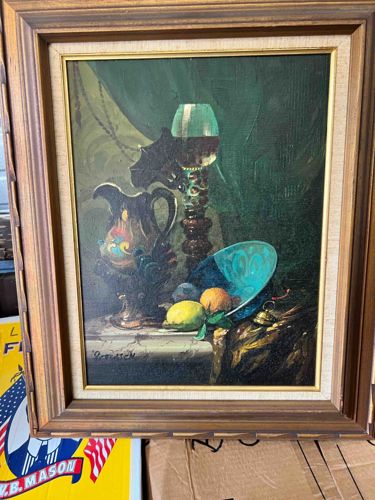
This item is an oil painting depicting a 'Vanitas' or still life composition, framed in a multi-toned wooden frame. The painting features an arrangement of objects against a dark, draped green background. On the left, a tall, ornate pitcher or ewer with a handle is visible, decorated with colorful, almost iridescent patterns in blues, reds, and yellows. To its right, there's a tall, stemmed goblet or lidded vessel with a textured or carved base, appearing to be made of a dark, possibly carved wood or metal, topped with a greenish-blue cup or bowl that contains a darker liquid. On a light-colored ledge or table surface, a turquoise or teal colored bowl, possibly glass or ceramic, holds an assortment of citrus fruits, specifically two lemons and an orange, along with some green leaves. Another small, metallic, bell-shaped object is visible to the right of the fruit. The overall color palette is rich and somewhat muted, typical of traditional still life painting, with dark greens, browns, and pops of bright fruit and pottery colors. Brushwork appears visible, suggesting a textured application of paint. The signature, an indistinct 'Duroch' or similar, is located in the lower-left quadrant. The frame itself is a multi-layered design, featuring an inner white or off-white liner, followed by a thin gold-toned fillet, and then a wider, outer frame with a simulated wood grain pattern in varying shades of brown. The frame shows some signs of use or age, with minor scuffs and wear visible. The painting technique appears to be representational with some expressive qualities.
AI Appraisal Report
This still life oil painting, framed in a multi-toned wooden frame, depicts a classic 'Vanitas' composition with pottery and fruit against a dark green backdrop. Based on my visual examination, the condition of the painting appears good, with no obvious signs of significant damage such as tears, punctures, or widespread paint loss. The visible brushwork suggests a textured application, which is consistent with oil painting. The frame shows minor scuffs and wear commensurate with age and use, which is typical and generally does not detract significantly from value in this price range. Authenticity, based solely on the indistinct signature 'Duroch' (or similar) in the lower-left quadrant and visual style, is difficult to definitively confirm without further research into this specific artist.
Market conditions for traditional still life paintings by unestablished artists are moderate. Similar works by regional or unknown artists typically fall into a decorative art category. Comparables found in local and online auctions for this genre and quality range from $400 to $1,000. Demand is steady for appealing decorative pieces. Rarity is not a significant factor here; while unique, it's not by a known collectible artist. The visual appeal, condition, and subject matter are the primary drivers of value.
Limitations in authenticity verification from images alone are significant. A full in-person examination would be needed to assess the true condition of the paint layer, canvas, and stretcher, as well as to investigate the signature more closely under magnification. Provenance documentation, such as purchase receipts or exhibition history, would be crucial for verifying authorship. Scientific testing, like pigment analysis, could confirm historical consistency but is usually reserved for higher-value works or when authenticity is strongly disputed.