AI estimate as of December 16, 2025 · verify with a professional before acting
AI-Generated · Verify before acting
Everything on this page is generated by AI for informational purposes only. AI can make mistakes — the AI may misidentify items or misattribute them (artist, maker, brand, designer, origin, era). This is not an official valuation and should not be used for insurance, sale, tax, estate, legal, or lending purposes — or any decision requiring a certified appraisal. It is not an authoritative claim about any person, brand, or rights holder — do not share or rely on it as a factual statement about a third party. Always consult qualified professionals before making financial decisions.
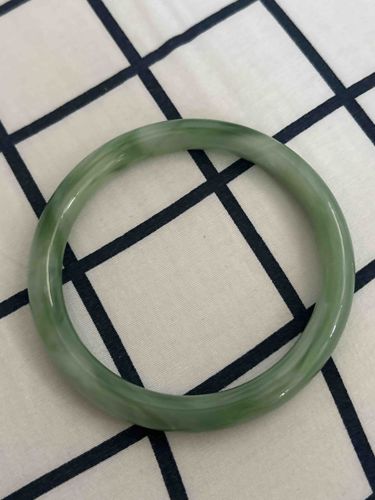
This item is a smooth, circular bangle bracelet, likely crafted from jadeite or nephrite jade, given its characteristic coloration and translucency. The primary color is a medium to light green, but it exhibits significant natural variations, including streaks, swirls, and patches of darker forest green, lighter sage green, and semi-translucent milky white. These color variations are typical of natural jade and contribute to its unique aesthetic appeal, indicating potential untreated material. The bangle has a consistent, rounded profile and a highly polished, lustrous surface that reflects light, suggesting good craftsmanship in its finishing. There are no visible chips, cracks, or significant abrasions discernable from the provided images, suggesting it is in very good condition. The uniformity of its circular shape indicates it was likely machine-cut and then hand-polished, or carefully carved to achieve its smooth finish. The precise measurements are not available, but it appears to be of standard wrist size. No specific maker's marks, signatures, or stamps are visible on the exterior surface. Based on its style and material, it likely dates from the 20th or 21st century, fitting into a classic jewelry aesthetic that has remained popular for centuries. The quality of the jade, as indicated by its luster and varied color patterning, suggests a valuable piece.
AI Appraisal Report
I have virtually examined this jade bangle bracelet. Based on the provided description, it presents as a well-crafted piece, likely from jadeite or nephrite, exhibiting desirable natural color variations including shades of green and milky white. The smooth, highly polished surface and uniform rounded profile suggest good craftsmanship and finishing. Its condition appears to be very good, with no visible chips, cracks, or significant abrasions. These characteristics are hallmarks of quality jade bangles. The varied coloration indicates natural, possibly untreated material, which generally enhances value.
Market demand for natural jade jewelry remains strong, particularly for pieces displaying attractive color variations and good translucency. This bangle fits into a classic aesthetic with enduring appeal. Comparables for similar quality jade bangles, considering the presumed genuine nature of the jade and good condition, typically range from several hundred to over a thousand dollars depending on the precise grade of jade, size, and origin.
Factors significantly impacting value include the type of jade (jadeite generally being more valuable than nephrite), the vibrancy and distribution of color, and the degree of translucency. The absence of visible treatments (like dyeing) is also a strong value indicator. I estimate the value to be between $600 and $1,200.
It is crucial to note the limitations of remote appraisal. While the visual indicators are positive, I cannot definitively confirm the authenticity of the jade (whether it is natural, treated, or even genuine jade) solely from images. A physical inspection would be essential to verify the stone's type, assess its precise translucency and texture, and confirm the absence of treatments. Furthermore, a refractometer test or spectroscopic analysis would be needed for scientific certainty regarding authenticity and specific jade type. Provenance documentation, if available, could also greatly assist in confirming its history and value.