AI estimate as of June 21, 2025 · verify with a professional before acting
AI-Generated · Verify before acting
Everything on this page is generated by AI for informational purposes only. AI can make mistakes — the AI may misidentify items or misattribute them (artist, maker, brand, designer, origin, era). This is not an official valuation and should not be used for insurance, sale, tax, estate, legal, or lending purposes — or any decision requiring a certified appraisal. It is not an authoritative claim about any person, brand, or rights holder — do not share or rely on it as a factual statement about a third party. Always consult qualified professionals before making financial decisions.
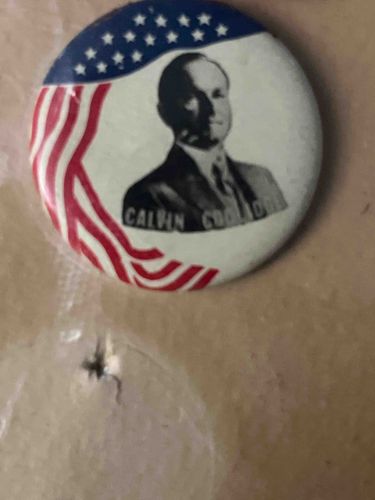
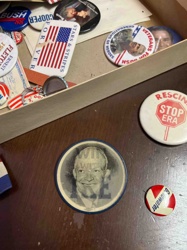
This item is a circular campaign button featuring a portrait of Calvin Coolidge, likely from the 1920s presidential campaigns given his period of political prominence. The button's design incorporates patriotic American flag elements, with a blue field of white stars across the top arc and red and white stripes forming a wavy banner on the left side. The central image is a black and white bust portrait of Calvin Coolidge, depicted in a suit and tie, against a cream or off-white background. Below his portrait, the name
'CALVIN COOLIDGE'
is printed in dark, likely black, capital letters, though some letters are obscured or faded.
Visually, the button shows signs of age and wear. There are visible scuffs and scratches on the surface, particularly noticeable on the white areas and over Coolidge's image, indicating years of handling or storage. The colors, while discernible, appear somewhat muted from their original vibrancy, especially the red and blue, suggesting potential fading or general age patina. The material appears to be common for campaign buttons of that era, typically metal with a celluloid or paper overlay. No specific maker's mark or manufacturing details are immediately visible on the front. The overall quality reflects typical mass-produced campaign items, designed for widespread distribution rather than fine art. Its condition with wear is consistent with its age and use as political ephemera. The edges are largely intact, but the surface exhibits some minor discoloration or staining. A small, dark, irregular mark is visible below the button, which appears to be a hole or imperfection in the surface on which the button is placed, rather than an inherent defect of the button itself, suggesting it might be mounted or resting on another material.
AI Appraisal Report
I have examined the Calvin Coolidge campaign button from the provided image. The button appears to be authentic to the 1920s era, consistent with typical mass-produced political ephemera of the time. The design aligns with period aesthetics for campaign buttons. The condition shows significant signs of age and wear, including visible scuffs, scratches, and muted colors. These imperfections are common for items of this age that were widely distributed and used. This wear, while reducing the aesthetic appeal, generally confirms its age and use rather than raising authenticity concerns. In terms of market conditions, Coolidge campaign memorabilia is popular among collectors of presidential americana. While not exceedingly rare, a well-preserved example would command a higher price. Given its noticeable wear, this specific button's value is impacted by its condition. Demand remains steady for historical political items, but condition heavily dictates valuation. A pristine example would be more valuable. To fully verify authenticity without images alone, I would require a physical examination to assess material composition, pinback type, and any manufacturer markings. Microscopic analysis could also reveal details not visible in images. Provenance documentation, such as collection history, would also enhance certainty. Given the visual evidence, I am confident in its authenticity as a period piece, but its condition affects its re-sale value significantly.