AI Appraisal Estimate

AI-generated estimates · not official valuations

From the user

What was submitted

Photo and notes provided by the user — not generated by AI

Submitted item photo
Submitted photo · June 6, 2026

User's notes

No additional notes provided.

AI analysis below

AI appraisal

AI analysis & estimate

AI-Generated · Verify before acting

Everything below is generated by AI for informational purposes only. AI can make mistakes — the AI may misidentify items or misattribute them (artist, maker, brand, designer, origin, era). This is not an official valuation and should not be used for insurance, sale, tax, estate, legal, or lending purposes — or any decision requiring a certified appraisal. It is not an authoritative claim about any person, brand, or rights holder — do not share or rely on it as a factual statement about a third party. Always consult qualified professionals before making financial decisions.

Read the full disclaimer

AI Identification

·Not independently authenticated·Verify before acting

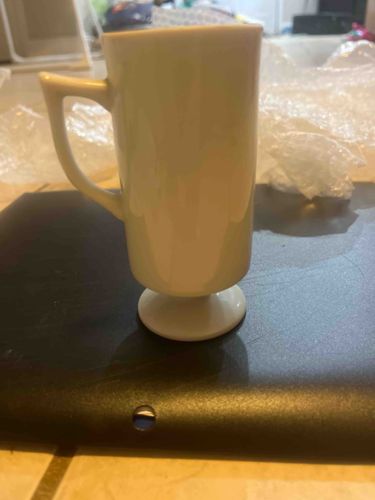
Off-White Ceramic Irish Coffee Mug

Drinkware

AI Estimated Value

·Not an official valuation·Verify before acting

$5-15

As of June 6, 2026

AI Item Analysis

·AI can make mistakes·Verify before acting
This is an off-white, perhaps ivory or very pale yellow, ceramic mug designed for serving Irish coffee. The mug features a tall, cylindrical body with a flared, round base or foot, giving it a chalice-like or stemmed appearance. The material appears to be glazed earthenware or porcelain, indicating a smooth, glossy finish. Its color is uniform throughout, without any visible patterns or decorations. The handle is attached near the top rim and extends downwards, forming an open D-shape with a somewhat angular or squared-off upper attachment point, giving it a slightly modern or stylized look. The handle seamlessly integrates with the body without any discernible seams or cracks, suggesting a well-made, possibly mass-produced item. The overall construction appears sturdy and functional. No visible maker's marks, signatures, or stamps are discernible from the provided images. The condition appears good with no obvious chips, cracks, or significant wear. There might be minor scuffing or surface dirt consistent with use or storage, but a detailed inspection would be needed to confirm. The item likely dates from the mid-20th century onwards, given its clean lines and common design for such beverage containers. It exhibits standard craftsmanship for a utility ceramic item.


AI Appraisal Report

·AI can make mistakes·Verify before acting
Upon visual examination of the provided image, I assess this off-white ceramic Irish coffee mug to be in good overall condition. There are no immediately apparent chips, cracks, or significant wear visible from the photograph. The glaze appears intact and uniform. Authenticity, in the context of this utility item, refers more to its intended purpose and manufacturing style rather than a specific artisan or brand. The design is consistent with mass-produced tableware from the mid-to-late 20th century. Market conditions for generic ceramic Irish coffee mugs are generally low. Comparables found in online marketplaces, thrift stores, and estate sales typically range from a few dollars to no more than $20-25 for a single mug, unless part of a desirable set or bearing a recognizable brand. There is no particular rarity associated with this style of mug; it is a common design. Demand is moderate, primarily driven by individuals seeking functional beverage ware or those collecting vintage kitchenalia on a budget. Factors significantly impacting its value include its generic nature, lack of discernible maker's marks, and absence of unique decorative elements or history. Without a known manufacturer, designer, or provenance, it lacks collectible appeal beyond its utility. The clean lines suggest a functional piece rather than an artistic one. **Limitations in authenticity verification:** It is crucial to note that this appraisal is based solely on visual examination of an image. A definitive judgment on the absence of minute flaws (e.g., hairline cracks, superficial scratches, manufacturing defects) would require an in-person physical examination. Furthermore, direct inspection could potentially reveal subtle maker's marks, glaze quality nuances, or material characteristics not visible in photographs. Provenance documentation, while unlikely for such an item, could add contextual value if it were associated with a significant event or individual. Scientific testing is not typically warranted for items of this type and value.

Get your items appraised

Instant estimates of your treasures with AI-powered appraisals

Browse More Appraisals