AI estimate as of September 5, 2025 · verify with a professional before acting
AI-Generated · Verify before acting
Everything on this page is generated by AI for informational purposes only. AI can make mistakes — the AI may misidentify items or misattribute them (artist, maker, brand, designer, origin, era). This is not an official valuation and should not be used for insurance, sale, tax, estate, legal, or lending purposes — or any decision requiring a certified appraisal. It is not an authoritative claim about any person, brand, or rights holder — do not share or rely on it as a factual statement about a third party. Always consult qualified professionals before making financial decisions.
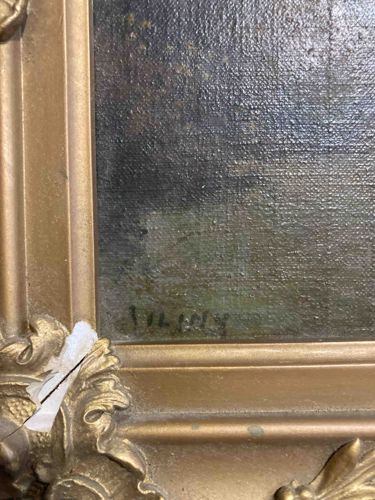
This item is an oil painting on canvas, housed within a substantial and ornate gilt frame. The painting itself appears to be a landscape or abstract scene, rendered in a dark, muted palette, predominantly featuring various shades of black, dark grey, and hints of dark green or brown. The paint application exhibits a visible texture, indicating a certain impasto or brushwork that gives depth to the surface. The canvas weave is discernible, especially in the close-up images, suggesting a medium-to-coarse grain. In the lower left quadrant of the painting, a signature or inscription is visible, appearing to read 'Vilgely' in a light, possibly white or pale yellow, handwritten script. The frame is a prominent feature, constructed from wood, likely carved or molded, and finished with a rich, antique gold gilt. It boasts intricate, rococo-style ornamentation, including scrolling acanthus leaves and decorative motifs at the corners and along the inner and outer edges. The frame shows signs of age and wear; notably, there is a significant chip or loss of material at the lower left corner, revealing a lighter material underneath, possibly gesso or bare wood. This damage is accompanied by flaking of the gilded surface. The overall patina of the frame suggests an estimated age from the late 19th to early 20th century, consistent with the style of the frame and the observable cracking in the gilt finish. The craftsmanship of the frame indicates a level of quality, despite the visible damage, typical of framed artworks of the period. The visible condition issues are consistent with age and handling.
AI Appraisal Report
Based on my visual examination of the provided image, this oil painting by 'Vilgely' within its ornate gilt frame presents a unique set of characteristics. The painting itself, a landscape/abstract in a dark, muted palette with discernible texture, suggests a mid-20th century aesthetic, though the signature 'Vilgely' is unfamiliar within prominent art historical records. The visible canvas weave and impasto application are consistent with oil painting techniques of the period.
The frame is a significant component, likely late 19th to early 20th century, with intricate rococo-style gilt work. Its age and craftsmanship contribute to its inherent decorative value. The notable chip and flaking at the lower left corner of the frame are significant condition issues that detract from the overall value. While the damage is consistent with age and handling, it requires repair to restore the frame's aesthetic integrity fully.
Market conditions for unsigned or lesser-known artists often rely heavily on decorative appeal and overall condition. The dark palette of the painting, while visually striking, may limit its broad market appeal compared to more traditionally vibrant landscapes. Demand for decorative antique frames remains steady, but the damage here offsets some of that demand. Rarity is difficult to assess without more information on the artist 'Vilgely'; if this is a unique piece by an uncatalogued artist, it possesses a certain rarity, though not necessarily high value.
My valuation is primarily driven by the decorative appeal of the combined piece, tempered by the condition issues of the frame and the unknown provenance/reputation of the artist. Without further information, the painting is valued as a decorative object rather than a fine art investment piece.
Limitations in authenticity verification from images alone are considerable. I cannot definitively verify the artist's identity ('Vilgely') or confirm the painting's originality without in-person examination, which would allow for detailed inspection of paint layers, canvas, and signature under magnification. Provenance documentation (exhibition history, sale records) would be crucial for establishing authenticity and market history. Scientific testing, such as pigment analysis, could verify the age and composition of the materials used.