AI estimate as of August 25, 2025 · verify with a professional before acting
AI-Generated · Verify before acting
Everything on this page is generated by AI for informational purposes only. AI can make mistakes — the AI may misidentify items or misattribute them (artist, maker, brand, designer, origin, era). This is not an official valuation and should not be used for insurance, sale, tax, estate, legal, or lending purposes — or any decision requiring a certified appraisal. It is not an authoritative claim about any person, brand, or rights holder — do not share or rely on it as a factual statement about a third party. Always consult qualified professionals before making financial decisions.
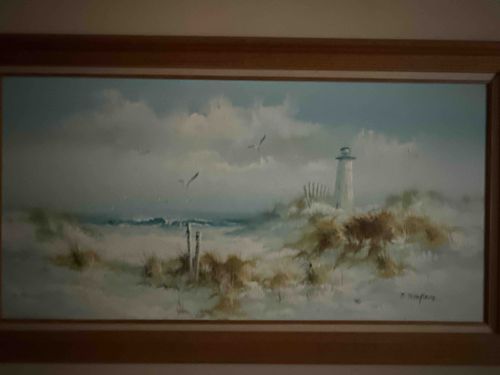
This item is a framed oil painting depicting a serene coastal landscape with a lighthouse. The painting features a soft color palette dominated by blues, grays, and sandy browns, typical of a muted, atmospheric beach scene. In the foreground, sandy dunes with sparse, dry grasses are clearly visible, rendered with textured brushstrokes that suggest their natural, somewhat windswept character. Towards the right, a prominent white lighthouse stands on a dune, with what appears to be a small fence or barrier behind it, adding depth and narrative to the composition. The mid-ground shows a turbulent sea with white-capped waves breaking on the shore, while the background and sky are filled with expressive clouds, suggesting either an overcast day or the atmospheric conditions near the coast. Several seagulls are depicted in flight in the sky, enhancing the coastal feel. The artist's signature, "e. morais" or similar, is visible in the lower right corner, indicating a potential manufacturing detail. The painting is housed in a simple, solid wood frame with a natural or light stain, exhibiting clean lines and a classic, unembellished profile. The overall condition appears good, with no obvious signs of damage, significant wear, or repairs visible in the provided image. The craftsmanship appears competent, with a clear attempt at capturing light and texture, indicative of a decorative art piece, likely from the mid to late 20th century.
AI Appraisal Report
Upon visual examination of this Coastal Lighthouse Oil Painting by E. Morais, the condition appears good; there are no obvious signs of damage, significant wear, or repairs. The muted color palette and subject matter are typical of decorative art from the mid-to-late 20th century. While the signature resembles 'E. Morais,' without physical inspection, I cannot definitively confirm its authenticity or whether it belongs to a listed artist or is a decorative signature. Many such pieces were produced for mass appeal. The craftsmanship is competent, capturing light and texture effectively, which suggests a decorative piece intended for broad market appeal rather than a fine art investment.
Market conditions for decorative coastal landscapes are generally stable but do not command high prices unless by a highly collected artist. This piece falls into a category of agreeable, mass-market art, often found in home decor settings. Demand for such pieces is moderate, driven primarily by aesthetic appeal rather than rarity. Similar works, often by unlisted artists or mass-produced decorative art, typically sell in the range provided.
Factors impacting value include the lack of established provenance, the likelihood of this being a decorative piece rather than a unique fine art work, and the commonality of the subject matter. The simple, solid wood frame is appropriate but does not add significant value beyond presentation.
Limitations: Authenticity verification from images alone is severely limited. For full authentication and to ascertain if 'E. Morais' is a recognized artist, an in-person examination would be critical. This would allow for: 1) Examination of brushstrokes, paint consistency, and canvas type for stylistic analysis; 2) Blacklight inspection for repairs or inpainting; 3) Close examination of the signature for proper execution and comparison to documented examples; 4) Professional conservation assessment; and 5) Thorough provenance documentation from previous ownership.