AI Appraisal Estimate

AI-generated estimates · not official valuations

From the user

What was submitted

Photo and notes provided by the user — not generated by AI

Submitted item photo
Submitted photo · May 18, 2026

User's notes

No additional notes provided.

AI analysis below

AI appraisal

AI analysis & estimate

AI-Generated · Verify before acting

Everything below is generated by AI for informational purposes only. AI can make mistakes — the AI may misidentify items or misattribute them (artist, maker, brand, designer, origin, era). This is not an official valuation and should not be used for insurance, sale, tax, estate, legal, or lending purposes — or any decision requiring a certified appraisal. It is not an authoritative claim about any person, brand, or rights holder — do not share or rely on it as a factual statement about a third party. Always consult qualified professionals before making financial decisions.

Read the full disclaimer

AI Identification

·Not independently authenticated·Verify before acting

Vintage Maple Drop-Leaf Tea Cart

Vintage Furniture

AI Estimated Value

·Not an official valuation·Verify before acting

$250.00 - $450.00

As of May 18, 2026

AI Item Analysis

·AI can make mistakes·Verify before acting
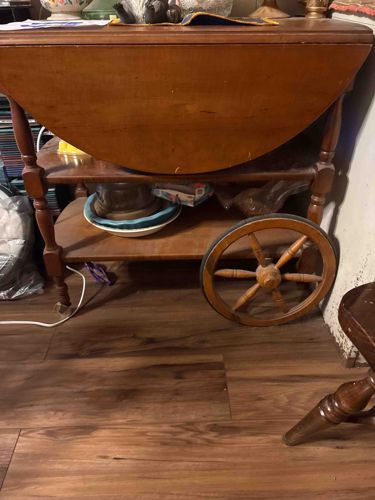
This is a mid-20th-century American Colonial Revival style tea or bar cart, likely manufactured between the 1940s and 1960s. The piece is constructed from solid wood, primarily maple or birch with a warm honey-amber stain and a semi-gloss finish. The design features a rectangular top with two semi-circular drop-leaf sides that expand the serving surface when raised. It includes two lower stationary shelves with chamfered edges for storage. The structure is supported by four baluster-turned posts. A defining aesthetic element is the large, decorative wagon-style rear wheels featuring six turned spokes and a rubber-treaded rim, balanced by smaller brass-toned or hooded ball casters at the front for mobility. In terms of condition, the cart shows moderate signs of age and utility appropriate for vintage furniture. There are visible surface scratches, scuffs, and minor impact dings along the edges of the drop-leaf and the lower shelves. The finish shows some unevenness and minor cloudiness in areas, reflecting a vintage patina. No major structural failures, such as deep cracks or loose joints, are immediately apparent. The craftsmanship is indicative of high-quality mass-produced Americana furniture of the era, typical of manufacturers like Cushman or Ethan Allen. The scale is modest, designed for domestic use in residential dining or living rooms.
AI Appraisal Report

·AI can make mistakes·Verify before acting
Based on my visual examination of this mid-20th-century American Colonial Revival tea cart, I have assessed its value within the current secondary market for Americana furniture. The piece exhibits the classic markers of the 1940s–1960s 'Honey Maple' era, likely produced by a reputable manufacturer such as Cushman or Ethan Allen. The construction displays solid joinery and iconic baluster-turned supports, which remain highly stable. The decorative wagon-style rear wheels are the primary value-add, as they represent the peak of this specific stylistic trend. Condition-wise, the visible surface scratches, minor dings, and finish cloudiness are consistent with a 'well-loved' domestic history. While these detract slightly from a 'mint' valuation, they confirm the vintage patina many collectors prefer over modern reproductions. Current market demand for Colonial Revival has softened significantly in favor of Mid-Century Modern; however, there remains a steady boutique market for functional, smaller-scale bar carts. Comparables for similar maple carts in retail vintage shops typically range from $300 to $500, while auction floor prices often settle between $150 and $250. Limitation Disclosure: This appraisal is based strictly on visual photographic evidence. From an image, I cannot definitively verify the wood species (distinguishing between maple and birch) or check for hidden structural repairs, dry rot, or the smoothness of the wheel bearings. A full authentication would require an in-person physical inspection to locate manufacturer branded heat-stamps on the underside, an assessment of the hardware’s interior oxidation, and provenance documentation to confirm the exact year of manufacture and retail history.

Get your items appraised

Instant estimates of your treasures with AI-powered appraisals

Browse More Appraisals