AI estimate as of October 12, 2025 · verify with a professional before acting
AI-Generated · Verify before acting
Everything on this page is generated by AI for informational purposes only. AI can make mistakes — the AI may misidentify items or misattribute them (artist, maker, brand, designer, origin, era). This is not an official valuation and should not be used for insurance, sale, tax, estate, legal, or lending purposes — or any decision requiring a certified appraisal. It is not an authoritative claim about any person, brand, or rights holder — do not share or rely on it as a factual statement about a third party. Always consult qualified professionals before making financial decisions.
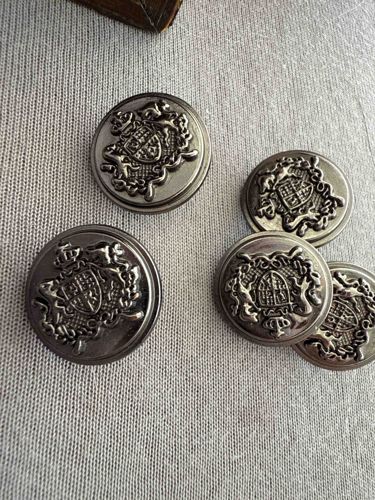
This is a set of five circular, domed metal buttons, likely crafted from a base metal such as pewter or a plated alloy, presenting a uniform dark silver or gunmetal gray finish. Each button features an intricately molded heraldic design on its face, centered around a shield or escutcheon. The shield itself appears divided into quarters or sections, possibly bearing miniature symbols or patterns that are difficult to discern precisely but suggest a coat of arms. Surrounding this central shield is a highly detailed, flowing scrollwork or foliate motif, giving the impression of an ornate crest. Above the shield, a small crown or coronet can be observed on several buttons, further reinforcing the aristocratic or formal nature of the design. The edges of the buttons are smooth and slightly raised, framing the central design. There are no visible maker's marks or signatures on the face of the buttons. The craftsmanship suggests a period style, possibly Victorian or early 20th century, given the elaborate detailing, though without a view of the backings, a precise age is difficult to pinpoint. The overall condition appears good with a consistent patina, indicating some age but no significant wear or damage visible from the front. The detailed relief work on each button is a notable feature, demonstrating a higher quality of manufacturing compared to simpler, stamped buttons. These buttons would have likely adorned formal wear, military uniforms (though less common for military given the apparent civilian heraldry), or high-end civilian garments such as blazers or overcoats.
AI Appraisal Report
Based on my visual examination of the provided image, this set of five ornate heraldic buttons appears to be in very good condition, displaying a consistent dark silver patina indicative of age without significant wear or damage. The intricate relief work and detailed heraldic design, including a central shield surrounded by scrollwork and a coronet, suggest a quality manufacturing process, likely from the Victorian or early 20th century. The uniform appearance across all five buttons points to them originating from the same ensemble.
Authenticity, based solely on imagery, appears strong for period manufacture. However, without inspecting the reverse of the buttons for shank construction, maker's marks, or material composition (e.g., specific metal hallmark), a definitive age and material identification common in appraisal of such items cannot be fully ascertained. These details often significantly impact value.
In terms of market conditions, buttons of this specific heraldic nature, while appealing to collectors of antique apparel accessories and militaria (though these lack definitive military insignia), occupy a niche market. Comparables for similar ornate, non-precious metal period buttons in sets of five tend to range from $50 to $150, depending heavily on provenance and specific historical association. The lack of a directly identifiable coat of arms or a known historical context limits a higher valuation for these particular buttons. Demand for general antique buttons is moderate, with rare or historically significant pieces commanding premiums. This set, while attractive, doesn't immediately suggest extreme rarity without further research into the specific heraldry.
Factors impacting value include the good condition and the detailed craftsmanship. Conversely, the unknown material composition, lack of maker's marks, and unidentified heraldry limit upward valuation. For full authentication and a more precise value, a physical inspection of the backings, examination under magnification to ascertain metal type, and potential research into the heraldic device would be necessary. Without these, the appraisal remains based on visual aesthetic and general market trends for comparable items.