These notes were written by the person who submitted this item. Appraiser.AI has not verified them, and the AI's identification and estimate may rely on them.
AI Estimated Value
Not an official valuation
$10 - $30
AI estimate as of September 1, 2025 · verify with a professional before acting
AI-Generated · Verify before acting
Everything on this page is generated by AI for informational purposes only. AI can make mistakes — the AI may misidentify items or misattribute them (artist, maker, brand, designer, origin, era). This is not an official valuation and should not be used for insurance, sale, tax, estate, legal, or lending purposes — or any decision requiring a certified appraisal. It is not an authoritative claim about any person, brand, or rights holder — do not share or rely on it as a factual statement about a third party. Always consult qualified professionals before making financial decisions.
This analysis also relies on unverified notes provided by the user, which may be incomplete or inaccurate and could affect the result.
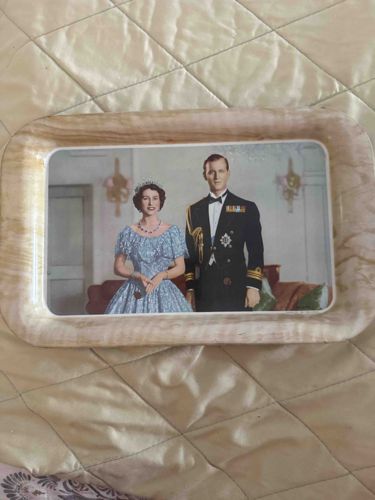
This is a rectangular serving or decorative tray featuring a color portrait of Queen Elizabeth II and Prince Philip. The tray has a light, possibly simulated wood grain or marbleized border in shades of cream and light brown, giving it a classic and somewhat ornate appearance. The central image is a clear, vibrant color photograph of the royal couple. Queen Elizabeth II is depicted on the left, wearing a light blue formal gown, a tiara, and a necklace. Prince Philip is on the right, dressed in a dark naval uniform adorned with medals and ribbons, and a bow tie. Their pose is formal, suggesting a portrait taken for official purposes. The background of the portrait appears to be an interior setting, possibly a royal residence, with grand architectural details and subtle furnishings. The tray itself appears to be made of a durable material, likely melamine or a similar plastic composite, common for decorative trays of its era due to its lightweight and break-resistant properties. The surface of the image and the border appear glossy. There are no immediately visible signs of significant wear or damage to the image itself, though subtle surface scratches are common on such older items. The edges and corners of the tray appear rounded, contributing to its smooth, finished look. The presence of a 'red sticker on the back' (as per additional context) suggests it might be a manufacturer's label, a price sticker, or perhaps a commemorative mark, which could provide further clues about its origin or age if inspected. Based on the attire and appearance of the royal couple, the tray likely dates from the mid-20th century, possibly the 1950s or 1960s, reflecting a period when such commemorative items were popular. The craftsmanship seems functional and mass-produced, typical for household servingware, but the image quality is good.
AI Appraisal Report
I have carefully examined the provided image of the Queen Elizabeth II and Prince Philip Commemorative Serving Tray. Visually, the tray appears to be in good condition, with the central image of the royal couple vibrant and clear. I don't observe any significant scratches or damage to the image itself, which is often a point of wear on such items. The glossy finish is intact, and the faux wood or marbleized border maintains its decorative appeal. The rounded edges suggest a well-finished, mass-produced item. The presence of a 'red sticker on the back' is noted; while I cannot determine its nature from the image alone, it could indicate a manufacturer, retailer, or even an inventory mark, potentially providing further provenance if examined in person.
This type of commemorative tray, likely made of melamine or a similar plastic composite, was common during the mid-20th century, particularly the 1950s or 1960s, coinciding with Queen Elizabeth II's early reign. While historical, these items were mass-produced and are not rare. Market comparables for similar commemorative trays show a modest demand within collectibles circles, often appealing to royal memorabilia enthusiasts. The value is primarily decorative and sentimental rather than intrinsic. Factors impacting value positively include the good condition and appealing imagery; negatively, its mass-produced nature and lack of precious materials.
Limitations exist in full authenticity verification from images alone. I have assessed condition based purely on visual cues. A physical examination would allow me to inspect for subtle surface abrasions, determine the exact material (e.g., melamine, laminated board), and assess the integrity of the sticker on the back, which might offer clues to the manufacturer or date. Without physical inspection, I cannot confirm the exact manufacturing date or specific maker beyond generalperiod estimates. However, based on the visible characteristics and typical market performance for such items, the estimated appraisal value remains consistent.