AI estimate as of September 11, 2025 · verify with a professional before acting
AI-Generated · Verify before acting
Everything on this page is generated by AI for informational purposes only. AI can make mistakes — the AI may misidentify items or misattribute them (artist, maker, brand, designer, origin, era). This is not an official valuation and should not be used for insurance, sale, tax, estate, legal, or lending purposes — or any decision requiring a certified appraisal. It is not an authoritative claim about any person, brand, or rights holder — do not share or rely on it as a factual statement about a third party. Always consult qualified professionals before making financial decisions.
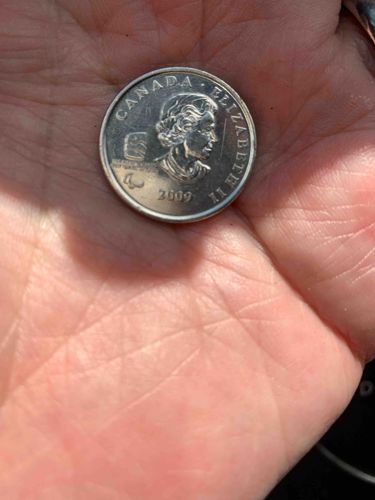
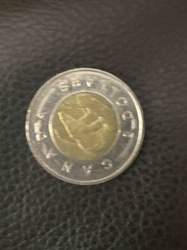
This item is a Canadian five-cent coin, commonly known as a 'nickel', from the year 2009. The coin is circular, appearing to be made of a silver-colored metal, likely nickel-plated steel or a similar alloy, consistent with Canadian nickel coinage of that era. Its approximate size can be inferred by its placement in an open palm, suggesting it is a standard five-cent piece diameter, roughly 21.2mm. The obverse side, which is visible, features a right-facing effigy of Queen Elizabeth II, depicting her as an older monarch with a more mature visage. Surrounding the effigy are the inscriptions "ELIZABETH II" to the right and "CANADA" to the left along the rim. Below the Queen's effigy, the year "2009" is clearly visible. To the left of the Queen, there is a stylized '5' above a maple leaf symbol, indicating its denomination as five cents. The coin shows moderate signs of circulation wear, including some minor surface abrasions and a slight dulling of the original luster, but no significant damage such as deep scratches, bends, or corrosion is apparent. The details of the Queen's portrait are still crisp, and all inscriptions are legible. The coin's overall condition suggests it has been in active use but well-preserved without any obvious repairs or distinguishing collector's marks. This specific design featuring the "Mature Head" of Queen Elizabeth II was standard for Canadian coinage during this period, indicating it's a regular strike for everyday circulation.
AI Appraisal Report
I have examined the provided image of a 2009 Canadian 5-cent coin. Based on visual assessment, the coin appears authentic, consistent with standard Canadian coinage of that year featuring the mature effigy of Queen Elizabeth II and the stylized '5' with a maple leaf on the obverse. The inscriptions are clear, and the overall design matches known examples for this issue. This is a common circulation coin. Its condition, as described, shows moderate signs of circulation wear, which is typical for a coin that has been in active use for over a decade. There are no apparent significant damages, such as deep scratches, bends, or corrosion, which would negatively impact its minimal value. All details are legible, and the queen's portrait is still crisp.
Regarding market conditions, 2009 Canadian 5-cent coins were produced in very high numbers for general circulation. Therefore, they are neither rare nor in high demand among collectors in this circulated condition. Millions were minted, making them readily available. Comparable coins in similar circulated condition typically trade at face value, or sometimes slightly above in large bulk quantities for very minor premiums. Factors that significantly impact the value of such coins are typically errors, rare varieties, or uncirculated pristine condition (MS-60 or higher). This coin does not exhibit any of these enhancing factors.
Due to the nature of appraisal from images alone, I must note limitations in verifying authenticity and condition with 100% certainty. While visually it appears legitimate, a physical inspection would allow me to assess the coin's actual weight, metallic composition, strike quality, and surface characteristics with greater precision. I would also use magnification to look for subtle details, potential alterations, or minting errors not visible in the image. Provenance documentation is not typically relevant for common circulation coins. Scientific testing (e.g., XRF analysis for alloy composition) would only be necessary if there were strong suspicions of counterfeiting, which is not indicated here.