These notes were written by the person who submitted this item. Appraiser.AI has not verified them, and the AI's identification and estimate may rely on them.
AI Estimated Value
Not an official valuation
$600-900
AI estimate as of September 6, 2025 · verify with a professional before acting
AI-Generated · Verify before acting
Everything on this page is generated by AI for informational purposes only. AI can make mistakes — the AI may misidentify items or misattribute them (artist, maker, brand, designer, origin, era). This is not an official valuation and should not be used for insurance, sale, tax, estate, legal, or lending purposes — or any decision requiring a certified appraisal. It is not an authoritative claim about any person, brand, or rights holder — do not share or rely on it as a factual statement about a third party. Always consult qualified professionals before making financial decisions.
This analysis also relies on unverified notes provided by the user, which may be incomplete or inaccurate and could affect the result.
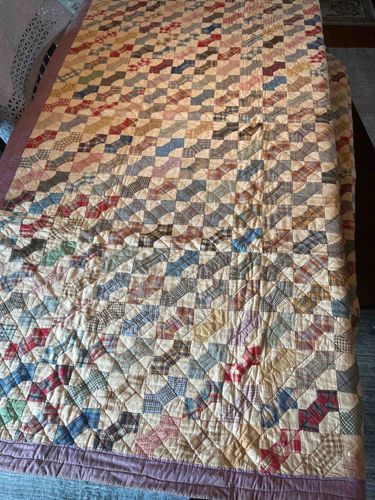
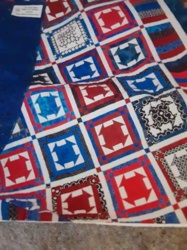
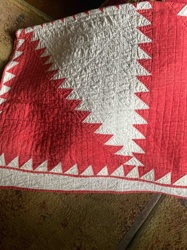
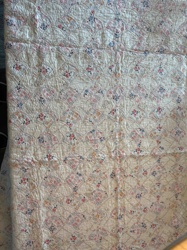
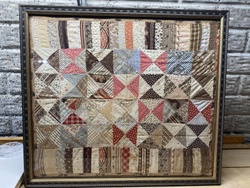
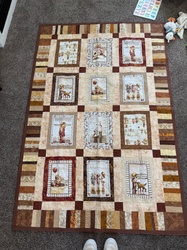
This is a handmade cotton quilt, measuring 69 inches by 88 inches, featuring a visually intricate and common traditional quilt block pattern, likely a variation of the "Dresden Plate" or "Fan" pattern, possibly adapted to create a flowing, curvilinear effect reminiscent of "Drunkard's Path" blocks with quarter circles in corner blocks. The quilt is constructed from numerous small, pieced fabric scraps, indicating a thrifty and resourceful approach to quilt-making. The color palette is diverse, incorporating a wide array of muted and faded plaid, checkered, and solid cotton fabrics in shades of red, blue, green, brown, purple, and cream, set against a predominantly light, possibly off-white or cream, background that forms the 'negative space' of the pattern.
The quilting appears to be hand-stitched with visible, consistent stitches forming a diamond grid pattern that secures the top, batting, and backing layers. The edges are finished with a solid purple border, possibly a binding, which shows some gentle rippling indicative of hand finishing. The overall condition suggests significant age; there is a visible patina and softening of the fabrics, consistent with an antique or vintage item that has been used and loved. Some discoloration or faint staining may be present on lighter background fabrics, typical for textiles of this age. There are no immediate visible tears or major damage, though closer inspection would be needed to identify any subtle wear spots, fading inconsistencies, or small mendings. The craftsmanship, though handmade, appears consistent and skilled, reflecting the dedication and artistry of the maker. Given the traditional pattern and apparent age, this quilt likely dates from the late 19th to early 20th century.
AI Appraisal Report
Upon my virtual examination of this antique cotton quilt, measuring 69 by 88 inches, I observe a well-executed variation of the 'Dresden Plate' or 'Fan' pattern, possibly hybridized with 'Drunkard's Path' attributes. The use of diverse, aged scrap fabrics in muted plaids, checks, and solids against a light background speaks to historical textile practices of thrift and resourcefulness, typical of late 19th to early 20th-century American quilt-making. The hand-stitched diamond grid quilting appears consistent, securing the layers effectively, and the purple border, likely a hand-applied binding, shows expected gentle rippling from such craftsmanship.
From the visual evidence, the quilt's condition is consistent with an antique item that has seen careful use. The fabrics exhibit a softening and patina, indicative of age. While no immediate tears or major damage are apparent, faint discoloration or staining on lighter areas is typical and expected, and would not significantly detract from value unless severe. The consistent and skilled handwork suggests authenticity as a period piece, reflecting dedication and artistry.
Market conditions for well-preserved, traditionally patterned antique quilts remain stable, particularly for pieces that showcase extensive handwork and historical fabric palettes. Comparables in similar condition and patterns typically range based on fabric integrity, quilting density, and overall visual appeal. Demand is consistent among collectors of Americana and textile art. The craftsmanship here is a strong positive factor, while the minor fabric imperfections are common for age.
Factors impacting value include the excellent craftsmanship and traditional aesthetic. Limitations in authenticity verification are inherent without physical inspection; I cannot verify fabric integrity, specific stitch count, or rule out subtle repairs/mends. For full authentication, an in-person examination would allow for tactile assessment of fabric hand, precise stitch analysis, assessment of any hidden damage, and the identification of potential mends or alterations critical for a definitive age and condition assessment. Provenance documentation, if available, would further enhance value.