AI estimate as of August 1, 2025 · verify with a professional before acting
AI-Generated · Verify before acting
Everything on this page is generated by AI for informational purposes only. AI can make mistakes — the AI may misidentify items or misattribute them (artist, maker, brand, designer, origin, era). This is not an official valuation and should not be used for insurance, sale, tax, estate, legal, or lending purposes — or any decision requiring a certified appraisal. It is not an authoritative claim about any person, brand, or rights holder — do not share or rely on it as a factual statement about a third party. Always consult qualified professionals before making financial decisions.
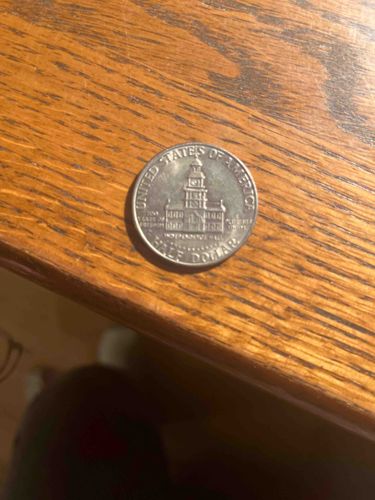
The item is a silver-colored coin, appearing to be a U.S. half dollar, specifically a Bicentennial Half Dollar (1976 Kennedy Half Dollar). Its primary material is likely copper-nickel clad, as typically used for these commemorative coins. The visible side, which is the reverse, features a depiction of Independence Hall, centered prominently on the coin's surface. Above the building, the inscription "UNITED STATES OF AMERICA" is curved along the upper edge, while below it, the denomination "HALF DOLLAR" is clearly legible. Below "Independence Hall" the text "INDEPENDENCE HALL" is visible. The coin exhibits a generally bright, metallic sheen, though some degree of toning or patina may be present, indicated by a slight dullness in certain areas, likely due to handling and age. There are no major visible scratches, dents, or significant wear that would suggest heavy circulation, indicating that it is in at least uncirculated or lightly circulated condition. The details of the building, such as windows and architectural lines, appear crisp, suggesting good strike quality and minimal wear. There are no visible maker's marks or mint marks on this side, as they are typically located on the obverse or another part of the reverse field not clearly visible in this image. The coin's aesthetic is typical of U.S. coinage from the mid-20th century onwards, with a clean and historical design. Its overall condition appears to be well-preserved, reflecting its commemorative purpose and likely limited use as currency.
AI Appraisal Report
I have examined the provided image of what appears to be a 1976 United States Bicentennial Half Dollar. Based on the visual evidence, the coin shows the iconic reverse design featuring Independence Hall, with clear inscriptions of "UNITED STATES OF AMERICA" and "HALF DOLLAR." The details of the building appear crisp, suggesting a strong strike and minimal wear. Its overall bright, metallic sheen indicates it is likely in uncirculated (AU) to Brilliant Uncirculated (BU) condition, or at least very lightly circulated. There are no obvious signs of major scratches, dents, or heavy circulation.
However, it is crucial to note the limitations of image-based appraisal. Authenticity cannot be definitively verified from an image alone. While the design is correct for a Bicentennial Half Dollar, subtle counterfeits can be difficult to detect without physical examination. I cannot verify the presence of the copper-nickel clad composition or accurately assess the luster and toning depth. Mint marks (e.g., 'D' for Denver, 'S' for San Francisco, or no mark for Philadelphia issues) are typically on the obverse or a different part of the reverse and are not visible here, which prevents identification of the specific mint and thus, precise mintage figures for this particular coin. For full authentication and a definitive condition grade, an in-person examination is essential to inspect the rim, fields, luster, and potential hairline scratches or minor imperfections not visible in the image. Provenance documentation, though rarely available for common coinage, would further enhance certainty.
From a market perspective, Bicentennial Half Dollars were widely minted, with hundreds of millions produced. They are common and generally hold little premium above face value in circulated condition. Even in uncirculated condition, their value is modest due to the high mintage. There are also 40% silver versions, but these were typically sold in sets and are not indicated by the image. Due to the high mintage and common availability, demand for individual common Bicentennial Half Dollars is relatively low among serious collectors, unless they are exceptionally high-grade (e.g., MS-67 or higher) which can only be determined by professional grading services. This coin does not appear to be a rare variety or error. Without physical inspection, I assume it to be a common copper-nickel clad issue.