AI estimate as of December 8, 2025 · verify with a professional before acting
AI-Generated · Verify before acting
Everything on this page is generated by AI for informational purposes only. AI can make mistakes — the AI may misidentify items or misattribute them (artist, maker, brand, designer, origin, era). This is not an official valuation and should not be used for insurance, sale, tax, estate, legal, or lending purposes — or any decision requiring a certified appraisal. It is not an authoritative claim about any person, brand, or rights holder — do not share or rely on it as a factual statement about a third party. Always consult qualified professionals before making financial decisions.
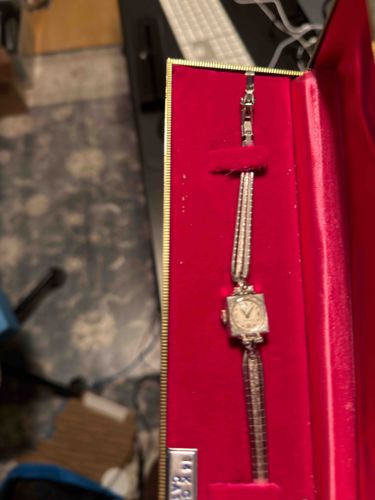
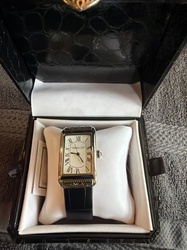
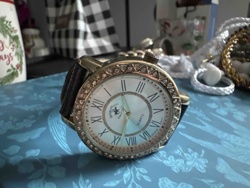
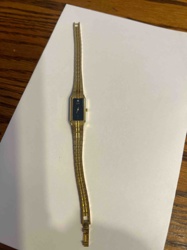
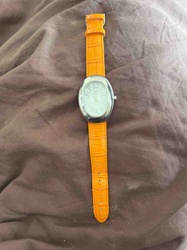
This item is a vintage ladies' cocktail watch, housed in what appears to be its original, red velvet-lined presentation box. The watch features a small, square-shaped watch head, likely crafted from a white metal such as sterling silver, white gold, or platinum, given its era and style. The watch face itself is light-colored, possibly white or cream, with hour markers that are not clearly visible but appear to be simple lines or dots, or potentially numerals, under the slightly aged crystal. The hands are delicate and dark. The bezel around the watch face appears to be embellished, possibly with small diamonds or marcasite, common for cocktail watches of the mid-20th century, adding a touch of sparkle. The watch is attached to a flexible, multi-strand or mesh-style bracelet, also in a white metal, which tapers slightly from the watch head. The clasp mechanism is not clearly visible but appears to be a fold-over style. The bracelet shows some signs of wear consistent with age, such as slight dulling of the metal and minor surface scratches. The overall condition suggests it has been worn but also carefully stored. The watch is presented inside a rectangular box with bright red velvet or satin lining on the interior, possibly gold-toned trim along the edges of the lining, and a lighter colored, rigid exterior (partially visible). The box itself is in good condition, indicating the watch may have been well-preserved. Based on the design cues, such as the small case size, decorative bezel, and bracelet style, this watch likely dates from the 1940s to 1960s, reflecting the popular mid-century style for women's timepieces. The craftsmanship appears delicate and refined, characteristic of watches intended for formal wear.
AI Appraisal Report
Based on my visual examination of the provided image, this vintage ladies' cocktail watch, presented in its original red velvet-lined box, exhibits characteristics consistent with mid-20th century design, likely dating from the 1940s to 1960s. The small, square watch head and flexible multi-strand or mesh bracelet in white metal are typical of the era. The embellished bezel, possibly with small diamonds or marcasite, adds a decorative element. The overall condition of the watch appears good for its age, showing expected wear such as minor surface scratches and slight dulling of the metal on the bracelet. The preservation of its original presentation box significantly enhances its appeal and perceived value.
Market conditions for vintage ladies' cocktail watches can be quite varied. While there is a steady demand for well-preserved examples, especially those with original packaging, the monetary value is typically not high unless the watch is from a prominent, high-end manufacturer (e.g., Rolex, Patek Philippe) or features significant precious stones. This piece appears to be a good quality, mass-produced item. Rarity is moderate; while many such watches were made, finding one in its original box and in this condition is less common. Factors impacting value include the type of white metal (sterling silver, white gold, or platinum – platinum would dramatically increase value), the material of the bezel embellishments, and the watch's movement (mechanical vs. quartz).
Without an in-person examination, verifying the authenticity of the materials (metal composition, type of stones), the manufacturer, and the watch's movement is impossible. A physical inspection would allow for testing of the metal, loupe examination of any stones, and assessment of the internal mechanism. Provenance documentation would further confirm its history and potentially its manufacturer, significantly aiding in a more precise valuation. Based on visual cues alone, I estimate its appraisal value to be between $150 and $300, assuming a non-precious white metal and common embellishments.