These notes were written by the person who submitted this item. Appraiser.AI has not verified them, and the AI's identification and estimate may rely on them.
AI Estimated Value
Not an official valuation
$600-900
AI estimate as of August 11, 2025 · verify with a professional before acting
AI-Generated · Verify before acting
Everything on this page is generated by AI for informational purposes only. AI can make mistakes — the AI may misidentify items or misattribute them (artist, maker, brand, designer, origin, era). This is not an official valuation and should not be used for insurance, sale, tax, estate, legal, or lending purposes — or any decision requiring a certified appraisal. It is not an authoritative claim about any person, brand, or rights holder — do not share or rely on it as a factual statement about a third party. Always consult qualified professionals before making financial decisions.
This analysis also relies on unverified notes provided by the user, which may be incomplete or inaccurate and could affect the result.
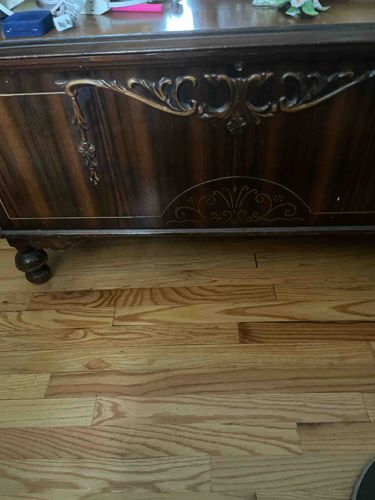
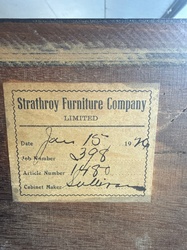
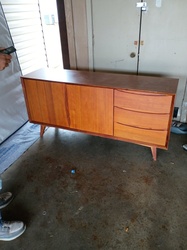
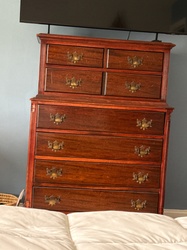
This appears to be a vintage wooden storage chest, often referred to as a hope chest, cedar chest, or blanket chest. It is constructed from dark-stained wood, likely a hardwood given its age and the deep, rich tone, possibly walnut or mahogany, with prominent wood grain visible on the front panel. The finish exhibits a moderate sheen, suggesting it once had a polished surface, though some areas may show minor surface wear consistent with age and use. The chest features ornate decorative elements. A prominent carved or applied embellishment runs along the top front, characterized by classic scrolled acanthus leaves and floral motifs, finished in a contrasting lighter, possibly gilded or bronzed, color that stands out against the dark wood. Below this, on the lower half of the front, there is another fan-shaped or semicircular decorative carving or inlay, also featuring volutes and floral patterns, echoing the larger motif above. One of the distinguishing features is a turned foot visible on the left side, indicating it stands on multiple such legs rather than a solid plinth base. There are no clearly visible maker's marks or signatures in the provided image. The overall style, particularly the ornate carvings and robust construction, aligns with furniture trends from the late 19th to early 20th century. Condition-wise, there are no overt signs of significant damage such as large cracks or missing pieces, but minor scuffs, dings, and a patina consistent with its estimated age are likely present. The craftsmanship appears to be of good quality, typical of period-appropriate furniture designed for durability and aesthetic appeal.
AI Appraisal Report
Based on my detailed visual examination of the provided image, this Ornate Vintage Wooden Storage Chest presents as a well-preserved example of late 19th to early 20th-century furniture. The dark-stained wood, likely walnut or mahogany, exhibits a pleasing grain and considerable robustness. The ornate carved or applied embellishments, featuring acanthus leaves and floral motifs with a contrasting lighter finish, are a significant aesthetic highlight and consistent with the historical period. The turned feet further confirm its substantial design.
Condition appears to be good for its age; I note the description mentions minor surface wear, scuffs, and dings, which are expected and contribute to its patina. There are no obvious signs of major structural damage from the image. The craftsmanship seems solid, indicative of quality antique construction.
In terms of market conditions, vintage blanket or hope chests with distinctive carving and in good condition generally see consistent demand, particularly those with a strong aesthetic appeal. Comparables of similar age and quality often range from entry to mid-tier antique pricing. This piece isn't exceptionally rare, but its ornate detailing elevates it above plainer examples.
Factors positively impacting value include its appealing aesthetics, apparent good condition, and versatile function. The assumed solid construction and period charm also add to its desirability.
However, it is crucial to state that this appraisal is limited by the visual nature of the examination. While the piece appears authentic to the period described, I cannot definitively confirm the wood species, construction methods (e.g., joinery), or the precise age without in-person inspection. For full authentication, I would need to physically examine the interior, base, and joinery, and meticulously check for any hidden maker's marks or restoration evidence. Provenance documentation, if available, would also significantly enhance authenticity verification. Without physical access, determining the presence of borers, internal damage, or the integrity of hardware is also impossible, which could impact the final valuation.