AI estimate as of October 22, 2025 · verify with a professional before acting
AI-Generated · Verify before acting
Everything on this page is generated by AI for informational purposes only. AI can make mistakes — the AI may misidentify items or misattribute them (artist, maker, brand, designer, origin, era). This is not an official valuation and should not be used for insurance, sale, tax, estate, legal, or lending purposes — or any decision requiring a certified appraisal. It is not an authoritative claim about any person, brand, or rights holder — do not share or rely on it as a factual statement about a third party. Always consult qualified professionals before making financial decisions.
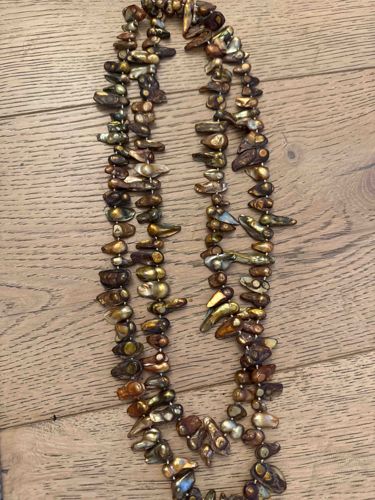
This appears to be a multi-strand necklace, likely composed of two or more strands, featuring baroque freshwater pearls. The pearls exhibit a wide range of irregular, organic shapes, characteristic of baroque pearls, rather than perfectly spherical ones. Their colors are predominantly earthy tones, including various shades of bronze, copper, gold, and dark brown, with some pearls showing iridescent overtones of green, blue, and purple, contributing to a rich, nuanced palette. The irregular shapes and varied colors give each pearl a unique character, preventing a uniform appearance across the strands. The pearls appear to be strung individually, possibly on a flexible cord or wire, with small knots or spacers visible between some of the larger pearls, which helps in securing them and preventing them from rubbing against each other. The overall construction suggests a robust but flexible design, allowing the necklace to drape naturally when worn. Given the photograph's resolution, specific details about the clasp or findings are not discernible, but it is likely a simple hook-and-eye or lobster clasp suitable for multi-strand designs. There are no visible prominent manufacturer's marks or signatures. The style suggests a modern, organic aesthetic, likely from the late 20th or early 21st century. Condition appears good with no obvious signs of damage, significant chips, or repairs, though a closer inspection would be required to assess the luster and surface quality of individual pearls more precisely. The quality indicators include the diverse and vibrant iridescence visible on many pearls, which is a desirable characteristic of well-formed freshwater pearls.
AI Appraisal Report
Upon visual examination of the provided images, this item appears to be a contemporary multi-strand necklace composed of baroque freshwater pearls. The pearls exhibit the characteristic irregular shapes and a diverse, earthy color palette of bronze, copper, and gold tones, with appealing iridescent overtones. The condition appears to be good, with no visible damage, chips, or signs of repair. The stringing seems secure, suitable for a multi-strand design.
The market for cultured freshwater pearl jewelry is extensive, and while pieces with unique coloration and shape like this are desirable, they are not exceptionally rare. Baroque pearls are generally more accessible and affordable than their perfectly round counterparts. Current market comparables for similar non-branded, multi-strand baroque freshwater pearl necklaces typically range from $100 to $200. The primary factors influencing this valuation are the pearl's luster, size, and the quality of the iridescence, alongside the craftsmanship of the necklace itself. The lack of a visible designer signature or precious metal clasp (assumed to be plated base metal without physical testing) places it within this more accessible price point.
It is important to note the limitations of an appraisal based solely on images. Without physical inspection, I cannot definitively determine the exact nacre thickness, test the metal content of the clasp, or confirm if the pearls are natural color or dyed. Full authentication would require in-person gemological testing to verify the pearls' origin and treatment status, as well as an acid test to identify the metal used in the findings. Therefore, this appraisal is provisional and contingent upon the materials being as they appear.