These notes were written by the person who submitted this item. Appraiser.AI has not verified them, and the AI's identification and estimate may rely on them.
AI Estimated Value
Not an official valuation
$50 - $100
AI estimate as of June 30, 2025 · verify with a professional before acting
AI-Generated · Verify before acting
Everything on this page is generated by AI for informational purposes only. AI can make mistakes — the AI may misidentify items or misattribute them (artist, maker, brand, designer, origin, era). This is not an official valuation and should not be used for insurance, sale, tax, estate, legal, or lending purposes — or any decision requiring a certified appraisal. It is not an authoritative claim about any person, brand, or rights holder — do not share or rely on it as a factual statement about a third party. Always consult qualified professionals before making financial decisions.
This analysis also relies on unverified notes provided by the user, which may be incomplete or inaccurate and could affect the result.
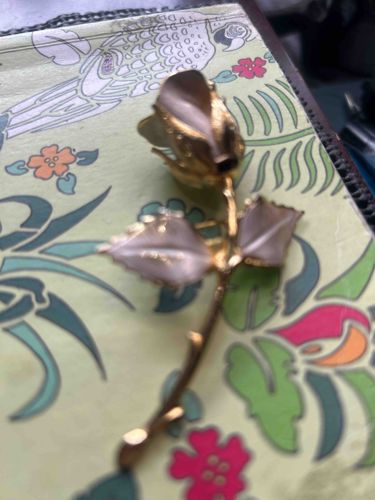
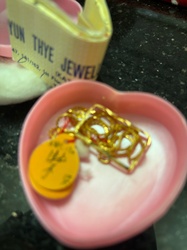
This item is a meticulously crafted rose-themed brooch or pin, designed to resemble a full rose on its stem. The overall aesthetic suggests a vintage piece, likely dating from the mid-20th century, possibly the 1950s to 1970s, characterized by its naturalistic floral form often seen in costume jewelry of that era. Physically, the brooch is constructed from a gold-toned metal, possibly gold-plated base metal, exhibiting both polished and matte finishes. The rosebud itself features a brushed or matte gold finish, with individual petals detailed, giving it a realistic, multi-layered appearance. There is some slight tarnishing or patina on the rosebud, contributing to its aged character. The two prominent leaves extending from the stem are enameled in an off-white or cream color, with raised gold-toned veining that mimics natural leaf structures. The stem is also gold-toned and notably features small, sharp, realistic-looking thorns, adding an authentic detail to the piece. The general condition appears good with expected wear consistent with its age, primarily visible as a darkening or dulling of the gold finish on the rosebud and potential minor surface scratches on the enameled leaves if inspected closely. No discernible maker's marks or signatures are visible from the provided images, suggesting it may be unbranded costume jewelry. The craftsmanship is notable for its attention to detail in replicating the organic form of a rose.
AI Appraisal Report
Based on my examination of the provided images and the detailed description, this rose-themed brooch appears to be a well-preserved vintage costume piece, likely dating from the mid-20th century (1950s-1970s). The craftsmanship, particularly the detailed rosebud with its textured finish and the enameling on the leaves with raised veining, is commendable, indicating a higher quality for its type. The presence of realistic thorns adds a unique touch.
The condition appears good for its age, exhibiting expected wear such as some darkening or patina on the rosebud and potential minor surface abrasions on the enameled leaves. This wear is consistent with its probable vintage, adding to its character rather than detracting significantly from its appeal.
In the current market for vintage costume jewelry, unbranded pieces like this typically attract collectors who appreciate unique designs and good craftsmanship but are not seeking high intrinsic material value. Comparables would include other floral-themed brooches from the same era, often gold-toned or gold-plated, with prices varying based on condition, appeal, and whether a designer is identified. Demand for well-executed costume pieces is steady but not exceptional, and this specific design, while charming, is not singularly rare in the broader context of mid-century floral brooches.
The primary factors influencing its value are its strong aesthetic appeal, good craftsmanship, and generally sound condition for a vintage item. Conversely, its likely base metal composition (gold-plated rather than solid gold) and the absence of a discernible maker's mark significantly limit its value compared to branded or fine jewelry pieces. The tarnishing, while contributing to vintage appeal, also indicates a base metal or plating.
It is crucial to note the limitations of an appraisal based solely on images. While the brooch's vintage authenticity as a costume piece seems evident from its style and apparent construction, a definitive assessment of its exact material composition (e.g., specific gold content or plating thickness), precise age (beyond a general era), and validation of any potential hidden marks simply cannot be made visually. A hands-on physical examination would be necessary to inspect the reverse for any elusive marks, assess weight and tactile quality, and perform specific gravity or XRF testing for precise metal identification. Provenance documentation, if available, would further enhance its historical context.