These notes were written by the person who submitted this item. Appraiser.AI has not verified them, and the AI's identification and estimate may rely on them.
AI Estimated Value
Not an official valuation
$150-250
AI estimate as of July 30, 2025 · verify with a professional before acting
AI-Generated · Verify before acting
Everything on this page is generated by AI for informational purposes only. AI can make mistakes — the AI may misidentify items or misattribute them (artist, maker, brand, designer, origin, era). This is not an official valuation and should not be used for insurance, sale, tax, estate, legal, or lending purposes — or any decision requiring a certified appraisal. It is not an authoritative claim about any person, brand, or rights holder — do not share or rely on it as a factual statement about a third party. Always consult qualified professionals before making financial decisions.
This analysis also relies on unverified notes provided by the user, which may be incomplete or inaccurate and could affect the result.
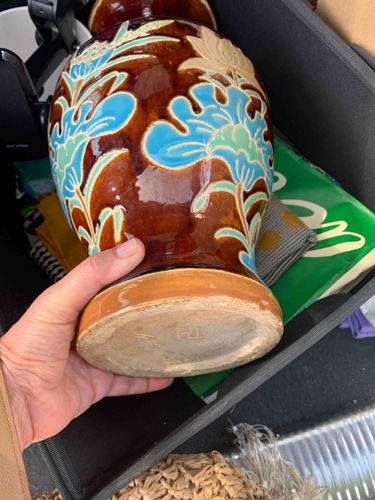
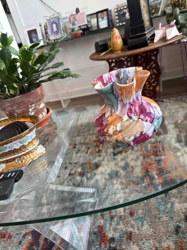
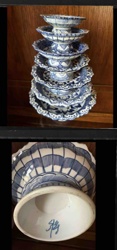
This is a ceramic art vase, likely of Japanese origin, possibly a Satsuma ware piece or in a similar style, exhibiting a prominent rich brown glaze on its body. The vase features a bulbous central body that tapers towards what appears to be a narrower neck and rim, though the very top is not fully visible. The primary decorative motif consists of raised, enamel-like floral patterns in vibrant blue, light blue, and pale green, outlined in a light, possibly gold or cream-colored, raised slip. The flowers are stylized, often depicted with multiple petals and leafy tendrils extending across the brown surface. The technique used for the decoration, where the colors are delineated by raised lines, is characteristic of moriage or raised enamel techniques found in Japanese ceramics. The base of the vase is unglazed, revealing the natural reddish-brown color of the ceramic body, indicative of earthenware or stoneware. This unglazed foot rim is substantial and shows some wear and dirt accumulation, suggesting age and handling. There is a visible impressed mark on the bottom of the base, which appears to be a manufacturer's or artisan's mark, crucial for identifying its origin, maker, and potentially its precise age. While the mark is somewhat obscured by dirt and texture, it could be a kanji character or a symbol. The craftsmanship appears to be of good quality, with attention to detail in the applied decoration. The glaze is glossy and intact across the decorated areas. There are no immediately obvious chips or cracks visible from the provided images, but the unglazed foot shows typical signs of wear from contact with surfaces. The robust potting and hand-decorated details suggest it is a studio piece or from a reputable pottery, potentially dating from the late 19th to early 20th century, a period known for export-oriented Japanese ceramics.
AI Appraisal Report
Upon examining the images of this Japanese ceramic vase, I have assessed it to be a fine example of Satsuma-style ware, likely produced during the late Meiji or Taisho period (circa 1890-1920) for the export market. The piece features a rich brown glaze, serving as a dynamic background for the vibrant, raised enamel, or 'moriage', decoration of stylized floral motifs. The quality of the hand-applied enamel work, with its distinct blue, green, and cream palette, is commendable and points to skilled craftsmanship. The unglazed, reddish-brown earthenware base with its impressed mark is characteristic of this period and style.
The vase appears to be in good condition for its age, with no major chips or cracks visible in the provided images. The wear on the unglazed foot is consistent with its age and use. The primary factor influencing its value is the quality of the moriage decoration and the overall aesthetic appeal. Comparable Satsuma and moriage vases of this era and quality typically perform consistently in the decorative arts market. While this style is not exceptionally rare, well-executed examples remain in demand by collectors.
However, this appraisal is based solely on visual information from photographs. A definitive authentication cannot be completed without a physical examination. In-person, I would need to closely inspect the impressed mark on the base to identify the maker or kiln, feel the texture of the glaze and moriage, and check for any hairline cracks or restorations not visible in photos. Confirming the authenticity of the mark and ruling out modern reproductions would be essential for a final valuation.